

What is Geothermal Energy?
Geothermal energy is the heat stored beneath the Earth’s surface, generated primarily by the decay of radioactive elements and residual heat from the planet’s formation. This subsurface energy flows outward from the Earth’s core through the mantle and crust, creating a continuous and measurable geothermal gradient.
Earth’s Internal Heat Source
At the center of the planet, the Earth’s core reaches temperatures above 5,000°C. Heat rises toward the crust through mantle convection, magma chambers, and geothermal flux. This natural transfer of thermodynamic energy drives hydrothermal systems such as hot springs, geysers, and steam reservoirs.
Scientific Meaning of Geothermal Energy
In scientific terms, geothermal energy refers to usable heat extracted from subsurface reservoirs. These include hydrothermal systems with hot water and steam, as well as deeper sources of dry rock and magma heat. The concept of heat flow, measured in watts per square meter, quantifies how geothermal energy moves from the Earth’s interior toward the surface.
A Renewable Heat Source
Geothermal energy qualifies as a renewable resource because the Earth continually produces internal heat at a scale far greater than human energy consumption. Unlike fossil fuels, geothermal power does not rely on finite reserves. Its constant replenishment makes it a sustainable option within the global energy transition toward low-carbon systems.

Key Attributes of Geothermal Energy
Attribute | Description | Examples / Values |
|---|---|---|
Energy Source | Heat generated inside the Earth from core, mantle, and crust. | Earth’s core (>5,000°C), mantle heat, magma chambers |
Geothermal Gradient | Increase in temperature with depth below the surface. | ~25-30°C per km in continental crust |
Heat Flow | Outward transfer of thermal energy from Earth’s interior. | Average – 0.065 W/m² (global heat flux) |
Reservoir Types | Natural underground systems storing hot water or steam. | Hydrothermal systems, hot dry rock, magma heat |
Scientific Meaning | Usable thermodynamic energy extracted from subsurface reservoirs. | Steam reservoirs, hot water aquifers |
Renewability | Constantly replenished by Earth’s internal processes. | Classified as renewable energy resource |
Energy Forms | Heat for direct use and electricity generation. | District heating, geothermal power plants |
Carbon Impact | Very low emissions compared to fossil fuels. | 97% lower CO₂ than coal power plants |
Role in Energy Mix | Provides continuous, reliable baseload power and heating. | Complements solar and wind in renewable systems |
As nations seek alternatives to coal, oil, and gas, geothermal power provides reliable baseload electricity and renewable heat. Unlike solar and wind, which are intermittent, geothermal energy delivers continuous output, supporting grid stability while reducing greenhouse gas emissions.
History and Evolution of Geothermal Energy

The history of geothermal energy begins with ancient civilizations that harnessed Earth’s natural heat for bathing, cooking, and heating long before the development of modern technology. From thermal baths in Rome to the first power plants in Italy, geothermal energy has evolved from a cultural tradition into a pillar of renewable power.
Ancient Geothermal Use
- Roman Empire – Thermal baths such as those in Pompeii used naturally heated waters from hydrothermal vents for relaxation and sanitation.
- China (circa 3rd century BCE) – Early heating systems used hot springs for space heating and medicinal purposes.
- Native American tribes – Hot springs across North America were used for cooking and spiritual rituals, reflecting geothermal energy origins in daily life.
Geothermal Energy in the Modern Era
- Larderello, Italy (1904) – Geothermal history reached a milestone when Prince Piero Ginori Conti tested the first geothermal power plant, lighting four light bulbs with steam from underground. This event marked the birth of geothermal power explained in industrial terms.
- 1920s-1950s – Expansion of geothermal pioneers included New Zealand and Iceland, where early geothermal plants supported growing electricity demand.
- The Geysers Plant, California (1960) – The world’s largest geothermal field began operation, eventually producing more than 1,500 MW of electricity, cementing the U.S. role in the global energy revolution.
Milestones in Geothermal Innovation
Period | Development | Examples |
|---|---|---|
Ancient Civilizations | Use of hot springs and natural hydrothermal systems for baths, heating, rituals | Roman baths, ancient spas in China |
1904 | First geothermal power generation in Larderello, Italy | Piero Ginori Conti experiment |
1920s-1950s | Early adoption of geothermal plants in volcanic regions | Iceland, New Zealand |
1960 | Large-scale commercial operation in the U.S. | The Geysers geothermal plant |
1970s-2000s | Global expansion during the renewable energy push | Philippines, Mexico, Indonesia |
Present | Integration into clean energy systems and advanced geothermal technologies |
Geothermal history demonstrates a transition from ancient spas and early heat use to modern baseload electricity generation. Its evolution highlights the role of geothermal pioneers in shaping today’s renewable energy landscape.
How Geothermal Energy Works

Geothermal energy works by extracting heat from underground reservoirs through wells, circulating fluids, and converting thermal energy into usable electricity or direct heat. This geothermal process relies on reservoir circulation, fluid loops, and subsurface pressure to deliver renewable power from Earth’s heat.
Geothermal Reservoirs and Wells
Geothermal reservoirs are underground pockets of hot water and steam trapped in porous rock formations. To access them, engineers drill production wells that bring hot fluids to the surface. After energy is extracted, cooled water is returned through injection wells, maintaining reservoir balance through reinjection.
Electricity Generation from Earth’s Heat
For power generation, geothermal mechanics involve –
- Hot Fluid Extraction – Superheated steam or hot water flows from production wells under subsurface pressure.
- Energy Conversion – Steam spins turbines connected to generators, producing electricity.
- Heat Exchanger Use – In binary-cycle plants, geothermal heat transfers to a secondary fluid with a lower boiling point, creating vapor to drive turbines.
- Reinjection – Cooled water is pumped back underground, sustaining reservoir circulation.
This closed-loop geothermal operation provides continuous baseload electricity with minimal emissions.
Direct Heating Applications
Shallow geothermal systems deliver renewable heat for buildings, greenhouses, and district heating networks. Fluid loops circulate geothermal heat directly into radiators, industrial processes, or spa facilities, making efficient use of moderate-temperature reservoirs.
Geothermal Heat Pumps
Geothermal heat pumps (GHPs) exploit stable ground temperatures within the top 100-400 feet of the Earth. In winter, fluid loops absorb ground heat and transfer it indoors via a heat exchanger. In summer, the process reverses, removing indoor heat and releasing it back into the ground. These shallow systems demonstrate how geothermal works at a household scale.
Types of Geothermal Systems
System Type | Depth | Process | Applications |
|---|---|---|---|
Dry Steam | 1-3 km | Steam from reservoirs drives turbines directly | Power generation |
Flash Steam | 1-2.5 km | High-pressure hot water flashes into steam at surface | Power plants in volcanic regions |
Binary Cycle | 0.5-2 km | Geothermal heat transfers to secondary fluid in a heat exchanger | Moderate-temperature reservoirs |
Direct Use Systems | <2 km | Hot water piped directly for heating | District heating, greenhouses, spas |
Geothermal Heat Pumps | 30-120 m | Ground-source fluid loops transfer heat between soil and buildings | Residential and commercial heating/cooling |
Geothermal heat extraction involves a cycle of production wells, turbines or heat exchangers, and reinjection wells, ensuring a sustainable geothermal operation.
Types of Geothermal Power Plants

Geothermal power plants are designed to convert underground heat into electricity using three main technologies – dry steam, flash steam, and binary cycle systems. Each geothermal power design depends on reservoir temperature, fluid conditions, and site-specific geology.
Dry Steam Plants
Dry steam plants are the oldest type of geothermal power system, first used in Larderello, Italy, in 1904. They tap reservoirs where natural steam rises directly through production wells and drives an expansion turbine connected to a generator.
- Pros – Simple design, high efficiency when pure steam is available.
- Cons – Limited to rare reservoirs with naturally dry steam.
- Best suited for – High-temperature, vapor-dominant fields such as The Geysers, California.
Flash Steam Plants
Flash steam plants are the most common geothermal energy systems worldwide. They extract geothermal brine at temperatures above 180°C. As pressure drops at the surface, part of the hot water undergoes phase transition into steam, which powers the turbine. Remaining liquid may be flashed again in a double-flash system for extra efficiency.
- Pros – Broad applicability, scalable design.
- Cons – Requires high-temperature reservoirs; produces dissolved gas emissions.
- Best suited for – Volcanic regions with abundant high-enthalpy geothermal reservoirs, such as the Philippines and Iceland.
Binary Cycle Plants
Binary cycle plants operate with moderate-temperature reservoirs (90-180°C). Geothermal brine passes through a heat exchanger, transferring heat to a secondary fluid with a low boiling point (e.g., isobutane or pentane). This organic Rankine cycle fluid vaporizes, drives an expansion turbine, and is condensed in a cooling loop for reuse.
- Pros – Can use lower-temperature resources, closed-loop design with near-zero emissions.
- Cons – Lower efficiency compared to flash or dry steam.
- Best suited for – Sedimentary basins or regions with medium-temperature hydrothermal systems.
Comparative Overview of Geothermal Plant Types
Plant Type | Reservoir Temperature | Working Principle | Pros | Cons | Examples |
|---|---|---|---|---|---|
Dry Steam | > 235°C | Steam directly powers turbine | High efficiency, simple design | Rare steam-dominant fields | The Geysers, USA |
Flash Steam | 180-235°C | Hot brine flashed into steam at lower pressure | Widely used, scalable | Gas emissions, scaling issues | Philippines, Iceland |
Binary Cycle | 90-180°C | Brine heats secondary fluid in heat exchanger (Rankine cycle) | Near-zero emissions, wider resource use | Lower efficiency, more complex equipment | Nevada, USA; Turkey |
Geothermal power plants range from dry steam systems using pure vapor to binary cycles optimized for lower-temperature geothermal brine. The choice of plant depends on geologic conditions, making geothermal power design adaptable across diverse environments.
Geothermal Applications – From Homes to Industry

Geothermal energy is used for electricity, building heating and cooling, greenhouse heating, district heating networks, industrial drying, and even spas. Its versatility allows geothermal applications to span residential, commercial, agricultural, and industrial sectors.
Residential and Commercial Heating
Ground-source heat pumps (GSHPs) provide thermal comfort by exchanging heat with shallow ground layers. Fluid circulating in a geothermal loop connects to a building HVAC system, supplying space heating in winter and cooling in summer.
- Advantages – Energy-efficient, reliable, and suitable for urban and suburban buildings.
- Example – Geothermal home heating in northern Europe and North America.
District Heating Networks
District heating systems deliver hot water from geothermal reservoirs to entire neighborhoods. Pipelines distribute renewable heat to thousands of homes, offices, and public facilities.
- Advantages – Reduces fossil fuel dependence, balances urban energy load.
- Example – Reykjavik, Iceland, where over 90% of homes use geothermal district heating.
Agricultural and Greenhouse Heating
Greenhouse heating from geothermal water ensures stable temperatures for crops year-round. Farmers also use geothermal energy for aquaculture ponds and geothermal drying of products like grains, onions, and timber.
- Advantages – Lower operational costs, consistent climate control.
- Examples – Geothermal agriculture in Hungary, the Netherlands, and Kenya.
Industrial Applications
Geothermal energy supports industrial drying, food processing, pulp and paper production, and chemical manufacturing. Medium-temperature geothermal brine can provide direct process heat, reducing natural gas consumption in factories.
- Advantages – Improves energy efficiency and reduces CO₂ emissions in energy-intensive industries.
- Example – Industrial drying of fish and timber in Iceland.
Recreational and Wellness Uses
Geothermal spas and hot springs represent one of the oldest uses of geothermal energy. Today, they remain popular for wellness tourism, combining hydrothermal resources with modern facilities.
- Examples – Blue Lagoon in Iceland, Beppu hot springs in Japan.
Overview of Geothermal Applications
Sector | Application | Example Uses |
|---|---|---|
Residential | Ground-source heat pumps (GSHPs) | Geothermal home heating, building HVAC load balancing |
Urban | District heating networks | Reykjavik city heating, Paris geothermal system |
Agriculture | Greenhouse heating, aquaculture, drying | Crop production, grain drying, fish farms |
Industry | Direct-use process heat, drying | Timber drying, pulp & paper, food processing |
Recreational | Geothermal spas and thermal baths | Blue Lagoon, Beppu hot springs |
Electricity | Baseload renewable power supply | National grids in Iceland, Philippines, Kenya |
The uses of geothermal energy extend far beyond power generation, supporting everything from geothermal home heating to industrial drying and agricultural productivity.
Geothermal Energy in the Global Energy Mix

Geothermal energy provides around 0.5% of global electricity generation, but it plays an outsized role in delivering continuous, dispatchable renewable power compared to solar and wind. Its contribution to the clean energy mix enhances energy security and grid stability through reliable base load energy.
Geothermal vs. Solar and Wind
According to the International Energy Agency (IEA), solar PV and wind dominate the renewable portfolio, accounting for more than 80% of new capacity additions in recent years. However, their intermittent nature requires backup systems or storage.
- Solar – High output during daylight but zero generation at night.
- Wind – Variable based on weather conditions, often with low capacity utilization.
- Geothermal – Operates at capacity factors of 70-90%, far exceeding solar (~20%) and wind (~35%), making it one of the most reliable renewable energy systems.
Baseload Advantages of Geothermal
Unlike variable renewables, geothermal electricity is a dispatchable power source, available 24/7 regardless of weather or daylight. This high load factor supports grid integration by providing continuous energy to balance fluctuations from solar and wind.
Global Energy Mix Insights
- Installed Capacity (2022) – ~16 GW worldwide, concentrated in countries along tectonic boundaries.
- Top Producers – United States, Indonesia, Philippines, Turkey, and New Zealand.
- Share of Renewables – Geothermal contributes less than 2% of global renewable generation, but in Iceland and Kenya it covers more than 40% of national electricity.
- Energy Diversification – Geothermal enhances resilience in the renewable portfolio by reducing dependence on variable sources.
Comparative Overview of Geothermal in the Renewable Mix
Technology | Global Capacity (2022) | Average Capacity Factor | Role in Energy Mix |
|---|---|---|---|
Solar PV | >1,000 GW | ~20% | Peak daytime supply, variable output |
Wind | ~850 GW | ~35% | Weather-dependent, medium reliability |
Hydropower | ~1,400 GW | ~45% | Large-scale dispatchable but climate dependent |
Geothermal | ~16 GW | 70-90% | Continuous baseload, high reliability |
Geothermal in the energy mix represents a small share of global renewables but provides critical base load energy and high capacity utilization, strengthening energy security and supporting energy diversification.
Country Spotlights – Leaders in Geothermal Energy

The top geothermal countries – Iceland, the Philippines, Kenya, the United States, and Indonesia – leverage volcanic activity and tectonic plate boundaries to generate significant shares of their electricity from geothermal hotspots. These geothermal leaders combine natural resource endowment with strong national energy policy to shape their renewable strategies.
Iceland
- Geologic Basis – Located on the Mid-Atlantic Ridge with intense volcanic activity.
- Energy Impact – Over 90% of homes are heated with geothermal district heating, and nearly 30% of electricity comes from geothermal plants.
- Policy Insight – Government-backed investment in geothermal zones transformed Iceland into a model for energy self-sufficiency.
Philippines
- Global Ranking – Second-largest geothermal power producer after the United States.
- Capacity – ~1,900 MW, supplying about 10% of national electricity.
- Policy Focus – Long-standing commitment since the 1970s to diversify energy and reduce oil imports.
Kenya
- Geologic Basis – East African Rift Valley geothermal zones provide high-enthalpy reservoirs.
- Energy Impact – More than 45% of Kenya’s electricity comes from geothermal power, giving it the highest national share globally.
- Economic Impact – Supports industrial growth and rural electrification, reducing reliance on hydropower vulnerable to drought.
United States
- Global Ranking – Largest geothermal electricity producer worldwide.
- Capacity – ~3,700 MW, concentrated in western states like California, Nevada, and Utah.
- Key Project – The Geysers field in California, the world’s largest geothermal complex.
- Policy Insight – Federal tax incentives and state-level renewable portfolio standards encourage geothermal expansion.
Indonesia
- Geologic Basis – Located on the Pacific “Ring of Fire,” home to vast untapped geothermal potential.
- Capacity – ~2,300 MW installed, ranking second globally in potential resources.
- Policy Focus – Aggressive investment programs aim to expand capacity to 6,000 MW by 2030.
Comparative Snapshot of Geothermal Leaders
Country | Installed Capacity (MW) | % of National Electricity | Key Geothermal Zones |
|---|---|---|---|
United States | ~3,700 | ~0.4% | California, Nevada, Utah |
Indonesia | ~2,300 | ~5% | Ring of Fire volcanic arc |
Philippines | ~1,900 | ~10% | Luzon and Visayas geothermal zones |
Kenya | ~950 | ~45% | East African Rift Valley |
Iceland | ~750 | ~30% (90% heating) | Mid-Atlantic Ridge volcanic fields |
These geothermal leaders demonstrate how volcanic activity, tectonic location, and policy alignment can transform geothermal hotspots into strategic pillars of the clean energy transition.
Environmental Benefits and Sustainability
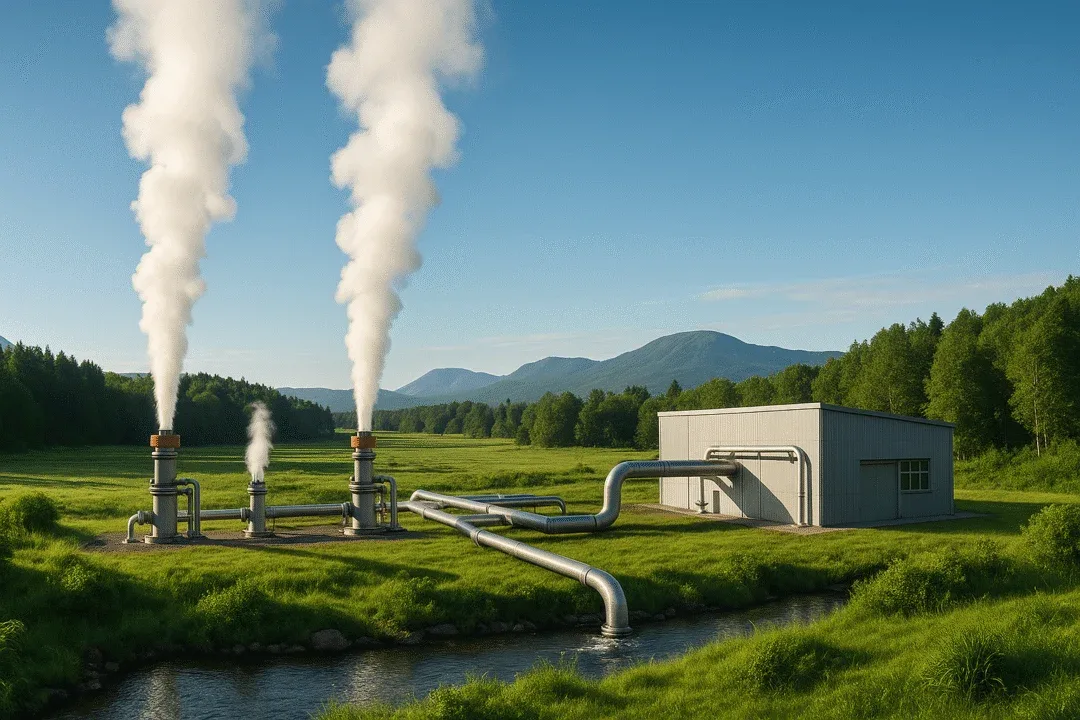
Geothermal energy has one of the lowest environmental impacts among renewable technologies, with minimal carbon emissions, small land use, and sustainable lifecycle performance. As a clean heat source, it supports global decarbonization while maintaining ecosystem balance.
Low Carbon Emissions
Compared to fossil fuels, geothermal emissions are 97% lower than coal and 94% lower than natural gas (U.S. Department of Energy). Most plants emit fewer than 50 g CO₂ per kWh, placing them on par with wind and lower than solar PV over the full lifecycle. This makes geothermal energy a key contributor to carbon offset strategies.
Lifecycle Sustainability
Lifecycle analysis confirms that geothermal electricity and heat have among the smallest carbon footprints in the energy sector. Once wells are drilled and infrastructure is in place, operations consume little fuel and rely on reinjection to maintain thermal sustainability.
Land and Water Use
- Land Footprint – Geothermal plants require less than 1-3 acres per MW, far smaller than solar or wind farms.
- Water Consumption – Closed-loop cooling and reinjection minimize water use, protecting hydrological balance and reducing surface impact.
Ecosystem Considerations
Because geothermal power plants have compact infrastructure, their surface impact is low. Reinjection of cooled fluids maintains reservoir pressure, ensuring ecosystem balance underground. With proper monitoring, geothermal energy avoids many environmental risks associated with fossil fuels.
Comparative Environmental Impact of Energy Sources
Energy Source | Lifecycle CO₂ Emissions (g/kWh) | Land Use | Water Consumption | Environmental Impact |
|---|---|---|---|---|
Coal | 820-1,050 | High (mines, plants) | High (cooling, washing) | Severe air pollution, high GHG emissions |
Natural Gas | 450-550 | Moderate | High (cooling) | Methane leakage, moderate emissions |
Solar PV | 40-50 | High (large farms) | Low | Habitat disruption in large installations |
Wind | 10-15 | Moderate | Low | Visual and wildlife impact |
Geothermal | 10-50 | Very low (1-3 acres/MW) | Very low (reinjection loop) | Minimal emissions, sustainable clean energy |
Sustainable geothermal energy combines ultra-low emissions, compact land use, and closed-loop water management, making it one of the cleanest and most reliable green energy solutions.
Challenges and Limitations of Geothermal Energy

Geothermal energy faces economic, geographic, and technical challenges that restrict its widespread adoption despite its environmental benefits. High drilling costs, site-specific feasibility, and seismic risks remain the main barriers to scaling geothermal power globally.
High Upfront Costs
The largest economic challenge is the cost of geothermal exploration and drilling, which can exceed $5-10 million per deep well. Uncertainty in locating viable geothermal reservoirs increases project risk, making financing more difficult compared to solar and wind projects with faster returns.
Geographic Constraints
Geothermal resources are highly concentrated in seismic zones and volcanic regions, creating geographic constraints that limit deployment. Countries on tectonic plate boundaries (e.g., Iceland, Indonesia, Kenya) have abundant geothermal zones, while other regions may lack the necessary resource potential.
Technical Feasibility and Risks
- Drilling Risk – Deep wells can encounter unexpected temperatures, pressures, or impermeable rock, reducing reservoir performance.
- Induced Seismicity – Fluid injection and reinjection may cause minor earthquakes in seismically active areas. While usually small, they can raise public concern.
- Resource Depletion – Overproduction without reinjection can lower reservoir pressure, reducing long-term output and creating project uncertainty.
Comparative Challenges of Geothermal Energy
Challenge | Description | Impact on Projects |
|---|---|---|
High Drilling Costs | Deep well cost ranges from $5-10M, with uncertain results | Increases project risk and financing barriers |
Geographic Limitation | Restricted to volcanic/seismic regions with geothermal gradients | Not universally deployable |
Technical Risk | Exploration uncertainty, drilling risk, reservoir depletion | Threatens long-term viability |
Seismic Concerns | Induced seismicity from reinjection in seismic zones | Public opposition and stricter regulations |
Project Uncertainty | Long lead times and uncertain feasibility outcomes | Slows global expansion compared to solar/wind |
The problems with geothermal energy stem from high capital requirements, geographic constraints, and technical risks such as induced seismicity and resource depletion. Addressing these geothermal energy challenges will require innovation in drilling technology, risk management, and financial support mechanisms.
Geothermal Technologies and Innovations

Recent geothermal technology breakthroughs are expanding the potential of geothermal energy beyond traditional hydrothermal fields. From Enhanced Geothermal Systems (EGS) to closed-loop designs and AI-driven drilling, innovative geothermal solutions are addressing past limitations and opening new frontiers.
Enhanced Geothermal Systems (EGS)
EGS energy involves creating artificial reservoirs in hot dry rock through rock fracturing and permeability enhancement. By injecting water into engineered fractures, heat is transferred and circulated to the surface.
- Innovation Impact – EGS expands geothermal access to regions without natural reservoirs.
- Current Status – Pilot projects in the United States, Europe, and Australia demonstrate the feasibility of large-scale advanced geothermal systems.
Closed-Loop Geothermal Systems
Closed-loop systems circulate a working fluid through sealed directional drilling pipes without direct contact with subsurface rock or water. This eliminates risks of contamination, scaling, or induced seismicity.
- Pros – Zero reservoir depletion, low surface impact.
- Applications – Emerging in both high-temperature and sedimentary basin environments.
Smart Sensors and Monitoring
Advanced geothermal operations now integrate smart sensors, temperature probes, and remote sensing systems for real-time monitoring of reservoir conditions.
- Machine learning algorithms optimize drilling paths, predict maintenance needs, and enhance safety.
- Result – Improved efficiency and reduced project uncertainty.
Nanotechnology in Fluids and Materials
Nanotech research is enhancing geothermal fluids and well materials for higher efficiency –
- Nanoparticles improve heat transfer properties of geothermal fluids.
- Advanced coatings increase durability of pipes and heat exchangers exposed to extreme conditions.
Future Outlook
Geothermal research continues to push the boundaries of feasibility. AI-driven drilling, closed-loop innovations, and EGS scalability could transform geothermal energy into a mainstream renewable solution capable of competing with wind and solar on a global scale.
Innovations at a Glance
Technology | Key Mechanism | Advantage | Stage |
|---|---|---|---|
Enhanced Geothermal (EGS) | Rock fracturing, permeability enhancement | Expands geothermal beyond natural zones | Pilot projects |
Closed-Loop Systems | Fluid circulation in sealed directional wells | No reservoir depletion, low seismic risk | Early commercial trials |
Smart Sensors & AI | Remote sensing, machine learning monitoring | Higher efficiency, predictive drilling | Active deployment |
Nanotech Applications | Nanoparticles & coatings in fluids/equipment | Better heat transfer, longer equipment life | Research & development |
Advanced geothermal systems – EGS, closed-loop designs, AI, and nanotechnology – are redefining geothermal innovation and expanding its role in the future clean energy portfolio.
Economics and Cost of Geothermal Energy

The economics of geothermal energy are shaped by high upfront capital costs (CAPEX), low operating expenses (OPEX), and long asset lifespans that enable favorable project ROI over decades. Despite investment risk during exploration, geothermal finance becomes highly competitive once plants are operational.
Capital Expenditures (CAPEX) and Operating Costs
- CAPEX – The largest cost driver is drilling and exploration, which may account for 30-50% of project costs. A single deep well can exceed $5-10 million.
- OPEX – Geothermal plants benefit from low operating margin requirements, with maintenance and reinjection costs typically lower than fossil fuel plants.
Levelized Cost of Energy (LCOE)
According to the International Renewable Energy Agency (IRENA, 2022), the global average LCOE for geothermal electricity is $0.05-0.10 per kWh, competitive with wind and solar in favorable resource zones. Unlike variable renewables, geothermal provides constant baseload output, improving grid value.
Project ROI and Payback Period
- Payback Period – Typically 5-10 years depending on resource quality and financing model.
- Project ROI – Enhanced by subsidies, loan guarantees, and tax incentives that reduce exploration and drilling risk.
- Long-Term Economics – Plants often operate for 30-50 years, ensuring strong returns after initial capital recovery.
Investment Incentives and Subsidies
Governments support geothermal finance through –
- Energy subsidies (feed-in tariffs, production tax credits).
- Risk mitigation funds to offset drilling uncertainty.
- International financing from development banks in emerging markets (e.g., East Africa Rift projects).
Comparative Cost Position of Geothermal Energy
Energy Source | Global Average LCOE ($/kWh) | CAPEX Intensity | OPEX Trend | Cost Competitiveness |
|---|---|---|---|---|
Coal | 0.05-0.15 | Medium (plants & fuel) | High (fuel purchase) | Declining due to emissions costs |
Natural Gas | 0.06-0.12 | Medium | High (fuel dependency) | Exposed to volatile gas prices |
Solar PV | 0.03-0.06 | Low (per MW) | Very low | Cheapest in sunny regions, variable output |
Wind | 0.04-0.08 | Medium | Very low | Competitive, weather-dependent |
Geothermal | 0.05-0.10 | High (exploration, drilling) | Low (stable OPEX) | Competitive in geothermal zones, baseload value |
Geothermal project economics hinge on balancing high upfront drilling costs with decades of reliable low-cost electricity. With favorable financing models and government incentives, geothermal ROI positions it as a strong competitor in the cost of renewable energy.
Case Studies – Successful Geothermal Projects

Large-scale geothermal plants such as Hellisheidi in Iceland, Olkaria in Kenya, The Geysers in California, Sarulla in Indonesia, and Wairakei in New Zealand showcase how geothermal success stories translate into reliable, low-carbon energy systems. These geothermal examples highlight plant design, performance, reinjection strategy, and long-term lifecycle performance.
Hellisheidi Geothermal Plant (Iceland)
- Capacity – ~300 MW electricity + 200 MW thermal for Reykjavik’s district heating.
- Key Features – Combined power and heat production; advanced reinjection strategy maintains reservoir pressure.
- Lesson Learned – Integration of power and district heating maximizes capacity utilization and supports national energy independence.
Olkaria Geothermal Complex (Kenya)
- Capacity – >850 MW across multiple units, providing over 45% of Kenya’s electricity.
- Key Features – High system stability from Rift Valley resources; international financing enabled expansion.
- Lesson Learned – Geothermal projects can deliver transformative stakeholder impact in developing economies.
The Geysers (California, USA)
- Capacity – ~1,500 MW, the largest geothermal system in the world.
- Key Features – Steam-dominant reservoirs; water reinjection from recycled wastewater sustains long-term output.
- Lesson Learned – Reinjection strategies are critical to lifecycle performance in mature geothermal zones.
Sarulla Geothermal Plant (Indonesia)
- Capacity – ~330 MW, one of the largest single-contract geothermal projects.
- Key Features – Utilizes both steam and binary-cycle technology for higher efficiency.
- Lesson Learned – Hybrid plant design optimizes resource use and expands geothermal feasibility in volcanic zones.
Wairakei Geothermal Plant (New Zealand)
- Capacity – ~175 MW, commissioned in 1958 as one of the world’s first large-scale geothermal plants.
- Key Features – Pioneering use of flash steam systems in hydrothermal fields.
- Lesson Learned – Early geothermal plant case studies prove long-term reliability with proper reinjection and monitoring.
Comparative Snapshot of Top Geothermal Systems
Project | Country | Capacity (MW) | Design Features | Key Lesson |
|---|---|---|---|---|
Hellisheidi | Iceland | 500 (300 MW + 200 MW heat) | Combined heat & power, reinjection strategy | District heating integration maximizes ROI |
Olkaria | Kenya | >850 | Multiple plants, high system stability | National-scale transformation in energy access |
The Geysers | USA | ~1,500 | Steam-dominant, wastewater reinjection | Reinjection sustains lifecycle performance |
Sarulla | Indonesia | ~330 | Hybrid flash + binary cycle | Technology mix boosts efficiency |
Wairakei | New Zealand | ~175 | Flash steam pioneer | Proof of long-term geothermal viability |
These successful geothermal projects demonstrate that with robust reinjection strategy, innovative plant design, and supportive financing, geothermal examples can achieve high capacity utilization and long-term system stability.
FAQ’s
What is geothermal energy?
Geothermal energy is heat from the Earth's interior that can be used to generate electricity and provide direct heating in buildings and industry.
How does a geothermal power plant work?
A geothermal plant extracts heat from underground reservoirs using wells. The heat turns water into steam, which spins a turbine to generate electricity.
What are the types of geothermal power plants?
The main types are dry steam, flash steam, and binary cycle plants, each suited to different geothermal resource conditions.
Where is geothermal energy used the most?
Top geothermal countries include Iceland, Kenya, the Philippines, the U.S., and Indonesia, where volcanic or tectonic activity is common.
What are the advantages of geothermal energy?
Geothermal energy offers low emissions, reliable baseload power, a small land footprint, and minimal environmental impact.
What are the disadvantages of geothermal energy?
Geothermal energy can be expensive to develop, site-specific, and may cause induced seismicity if not managed properly.
What is the cost of geothermal energy?
The LCOE for geothermal ranges from $40 to $100 per MWh, with high upfront drilling costs but low long-term operating expenses.
What is Enhanced Geothermal Systems (EGS)?
EGS is a technology that creates artificial geothermal reservoirs in hot dry rock by fracturing rock and circulating water through it.
Can geothermal energy be used for heating homes?
Yes. Ground-source heat pumps use shallow geothermal energy to provide efficient heating and cooling in residential and commercial buildings.
Is geothermal energy sustainable long-term?
Yes. With proper reservoir management and reinjection strategies, geothermal energy is renewable and sustainable for decades.
References and Sources
Center for Sustainable Systems, University of Michigan. – Geothermal Energy Factsheet
ENERGY.GOV – Geothermal Technologies Office – Geothermal Electricity Generation