

What Is a Food Web?
Imagine nature as a giant puzzle where every living thing has its own unique role. A food web is like a map that shows how animals and plants are connected by what they eat and who eats them. Unlike a simple food chain, a food web gives us a bigger picture of how life in an ecosystem truly works.
Key Concept Explained
A food web is a network of interconnected food chains in an ecosystem. It illustrates the many ways in which energy flows from one organism to another. Each organism occupies a trophic level, from producers that make their own food, to consumers that eat other organisms, and finally decomposers that break down dead material.
Why Not Just a Food Chain?
A food chain shows one straight line of “who eats whom.” But nature isn’t that simple. Most animals eat more than one thing, and they can be eaten by different predators. A food web helps us understand these complex interactions more accurately.
Example
- A rabbit might eat grass.
- A fox might eat the rabbit.
- But the rabbit could also be eaten by a hawk, and the grass might be eaten by a grasshopper.
In a food web, all of these relationships are connected, like a spider web made of feeding links.
The Flow of Energy
Every food web starts with the sun. Plants use sunlight to make energy through photosynthesis. That energy moves up the web as animals eat plants and then other animals.
- Producers (like grass) →
- Primary consumers (like grasshoppers) →
- Secondary consumers (like frogs or birds) →
- Tertiary consumers (like snakes or hawks) →
- Decomposers (like fungi and bacteria)
Each step is a trophic level, and energy is lost as heat at every step, which is why there are fewer top predators.
Key Terms to Know
- Ecosystem – A community of living things and their environment.
- Trophic level – A step in the food web based on how an organism gets energy.
- Biomass – The total mass of living things at each trophic level.
- Energy transfer – The movement of energy through the food web.
- Interdependence – The way organisms rely on each other to survive.

What Are Grasslands?
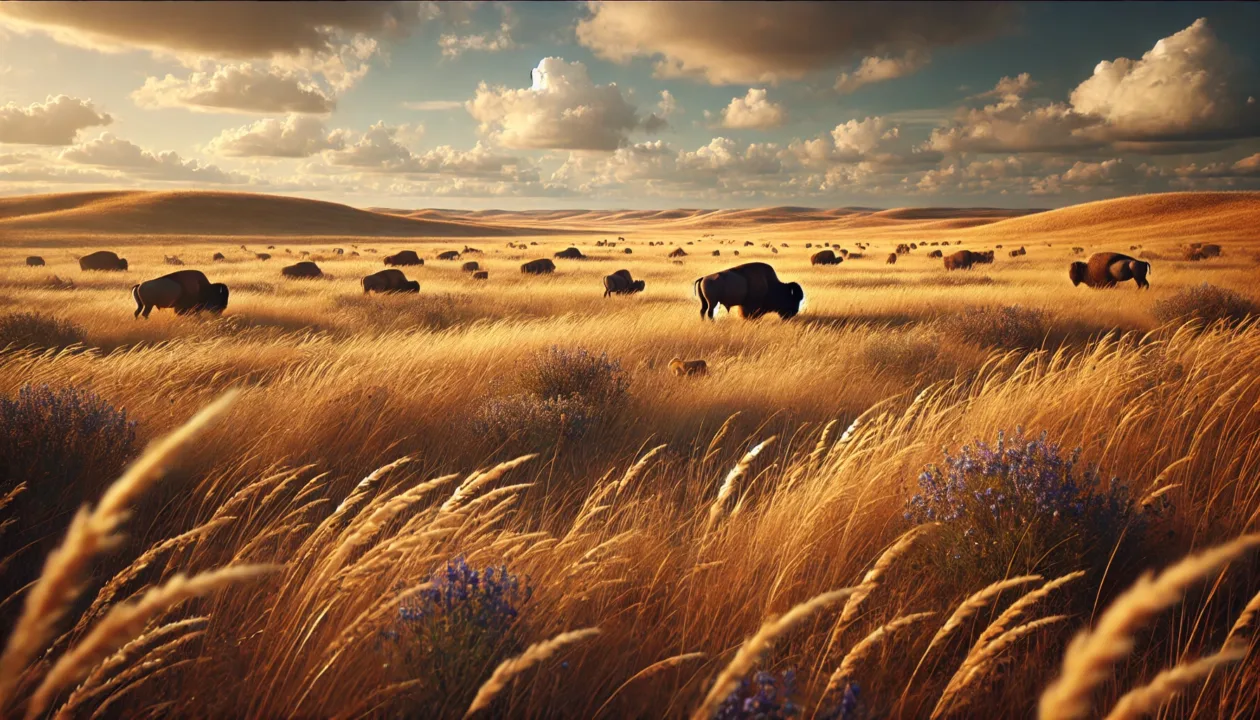
When you imagine wide-open spaces filled with swaying grasses, few trees, and large grazing animals, you’re picturing a grassland. These ecosystems might seem simple, but they’re actually packed with life, energy, and important roles in the global environment.
What Is a Grassland?
A grassland is a type of biome where grasses are the dominant plant life. Trees and large shrubs are rare, usually because of low rainfall, frequent fires, or grazing animals that prevent forests from growing. Despite this simplicity, grasslands support a diverse range of animals, plants, and microorganisms.
There are two main types of grasslands –
- Temperate Grasslands – Found in places like North America (prairies), South America (pampas), and Central Asia (steppes). These areas have hot summers, cold winters, and moderate rainfall.
- Tropical Grasslands (Savannas) – Found mostly in Africa, South America, and Australia. These have warm temperatures year-round with a distinct wet and dry season.
Climate and Soil
Grasslands usually form in regions that are too dry for forests, but too wet for deserts. Rainfall usually ranges from 20 to 35 inches (50 to 90 cm) per year.
- Soils are rich in nutrients because dead grasses decompose and return organic matter to the ground.
- Fires, natural or caused by lightning, are common and help recycle nutrients, prevent trees from growing too densely, and encourage grass regrowth.
Who Lives in the Grasslands?
Even without many trees, grasslands are full of life –
- Plants – Grasses (like bluestem, ryegrass), wildflowers, and tough shrubs.
- Animals – Grazers like bison, zebras, and antelope; predators like lions and foxes; and birds, insects, and reptiles adapted to open spaces.
- Microorganisms and fungi enrich the soil and help break down dead plant material.
Each species has adapted to survive the harsh winds, dry spells, and open visibility of the biome.
Examples of Famous Grasslands
- The North American Prairie (USA, Canada) – Home to bison, prairie dogs, and coyotes
- The African Savanna – Home to lions, elephants, and zebras
- The Pampas (Argentina) – Known for its fertile soil and grazing cattle
- The Eurasian Steppe – A historic region of horse-riding nomads and vast grassy plains
Why Grasslands Matter
Grasslands are essential to Earth’s health. They –
- Store carbon in their soils, helping regulate climate
- Provide food for humans and wildlife
- Serve as important grazing land for livestock
- Support biodiversity through complex food webs
But they’re also under threat from overgrazing, agriculture, and climate change.
Key Terms to Know
- Biome – A large natural area with distinct climate, plants, and animals
- Savanna – A tropical grassland with scattered trees
- Steppe – A cold, treeless grassland often found in Eurasia
- Prairie – A temperate grassland found in North America
- Fire ecology – How natural fires shape the health of an ecosystem

Producers in the Grassland Ecosystem

All life in a grassland ecosystem starts with one group of organisms – producers. These are living things that make their own energy – and they do it using sunlight. Without producers, the food web would collapse because there would be no energy entering the system.
In grasslands, producers are mostly grasses, but also include wildflowers, small shrubs, and a few hardy trees in some areas.
What Is a Producer?
A producer is an organism that can create its own food through a process called photosynthesis. In this process, plants take in sunlight, water, and carbon dioxide and convert them into glucose (sugar), which they use for energy and growth.
In doing so, they store energy that other organisms, like herbivores, can use when they eat the plant.
Main Types of Grassland Producers
Grasses
These are the most dominant and recognizable producers in any grassland biome. Examples include –
- Big bluestem
- Switchgrass
- Buffalo grass
- Ryegrass
- Bermuda grass
These grasses often have deep root systems that help them survive fires and drought.
Wildflowers and Forbs
These are small flowering plants that aren’t grasses, but still thrive in grasslands.
- Coneflowers
- Milkweed
- Goldenrods
They often provide important nectar sources for pollinators like bees and butterflies.
Shrubs and Low Trees (in tropical grasslands)
In African savannas and some temperate regions, shrubs and sparse trees like acacia and juniper also play a role in providing food and shelter.
Why Producers Are So Important
- They capture solar energy and turn it into a form that animals can use.
- They release oxygen during photosynthesis, supporting the atmosphere.
- They form the base of the food web, feeding herbivores like zebras, grasshoppers, or bison.
- Their roots hold soil in place, preventing erosion.
- They regrow quickly after fire, maintaining ecosystem stability.
How Do Grasses Survive Grassland Conditions?
Grasses are uniquely adapted to grassland challenges –
- Underground growth points (so fires or grazers don’t kill them)
- Flexible, narrow leaves to reduce water loss
- Extensive roots that soak up rain quickly and store water
- Ability to go dormant during droughts
These traits help them thrive where many other plants would struggle.
Energy Transfer from Producers
When a grazer eats grass, it gains energy that was originally stored from the sun. However, only about 10% of the energy at each level moves up the food chain. That’s why producers need to be abundant, they support everything else in the ecosystem.
Key Terms to Know
- Producer – An organism that makes its own food
- Photosynthesis – The process of converting sunlight into energy
- Autotroph – A scientific term for producers
- Biomass – The amount of living material in a given area
- Root system – The underground part of a plant that collects water and nutrients
Consumers – Herbivores, Carnivores & Omnivores
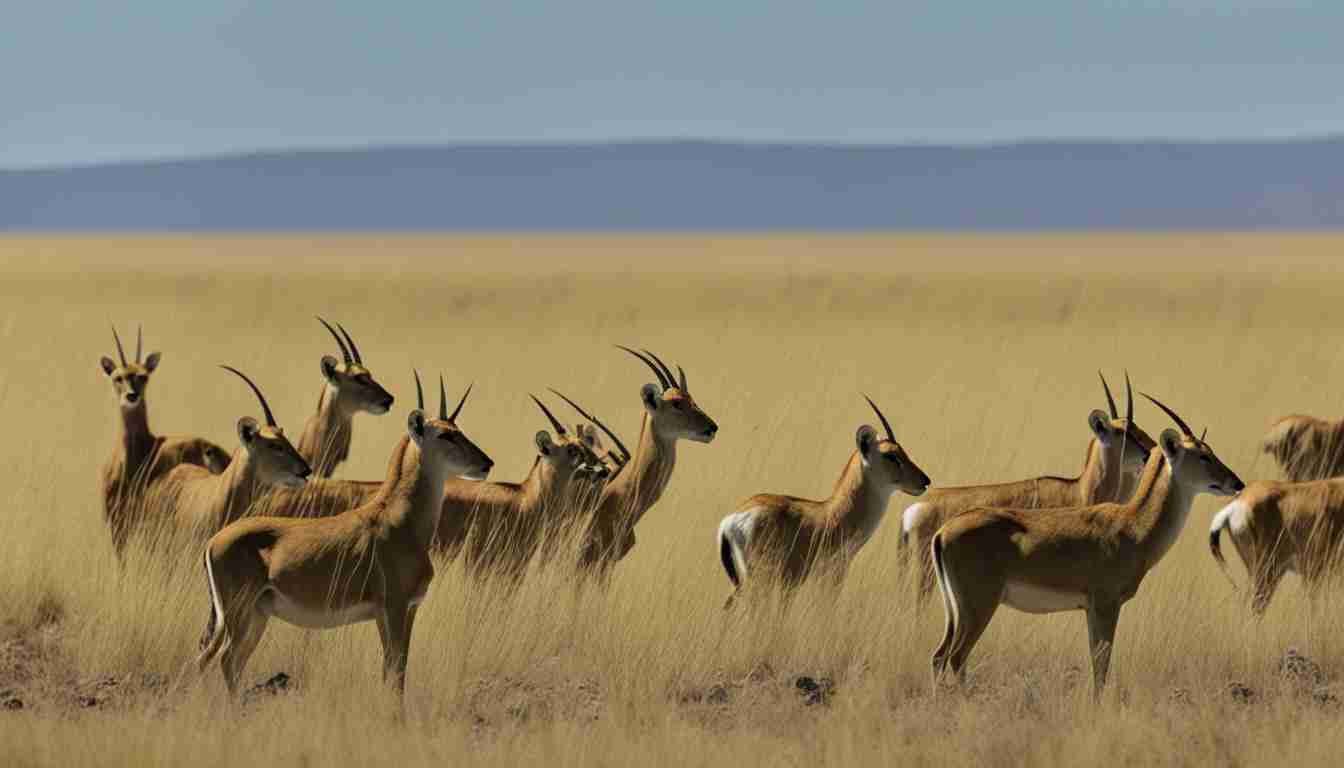
In a grassland food web, not every organism can make its own food like producers do. Most must eat other organisms to survive. These are called consumers. Depending on what they eat, consumers are divided into three main groups – herbivores, carnivores, and omnivores.
Each plays a specific role in energy transfer and ecosystem balance.
Herbivores – Primary Consumers
Herbivores are animals that only eat plants. In grasslands, they are the primary consumers because they feed directly on producers like grasses and shrubs.
Examples of grassland herbivores –
- North America – Bison, prairie dogs, rabbits
- Africa – Zebras, gazelles, wildebeest
- Asia – Saiga antelope
Key adaptations –
- Flat molar teeth for grinding tough plants
- Large digestive systems for breaking down cellulose
- Herd behavior for protection and migration
Herbivores are crucial for controlling plant growth and serving as food for higher-level consumers.
Carnivores – Secondary and Tertiary Consumers
Carnivores eat other animals, and they can be –
- Secondary consumers (eat herbivores)
- Tertiary consumers (eat other carnivores)
In grasslands, carnivores help regulate animal populations and maintain food web balance.
Examples –
- Secondary – Coyotes (eat rodents), jackals
- Tertiary – Lions (eat zebras), hawks (eat snakes)
Key adaptations –
- Sharp canines and claws for hunting
- Camouflage for stalking prey
- Keen senses (vision, smell, hearing)
Carnivores are usually fewer in number because there is less energy available at the top of the food web.
Omnivores – Flexible Feeders
Omnivores eat both plants and animals, giving them more options for finding food.
Examples –
- North America – Badgers, bears, some bird species
- Africa – Baboons, warthogs
- Worldwide – Many insects like ants and beetles
Advantages of being an omnivore –
- Adaptable to seasonal changes in food
- Able to survive in diverse environments
- Help with seed dispersal and scavenging
Omnivores often link multiple food chains together, increasing interconnectedness in the food web.
How Consumers Interact in the Food Web
Let’s follow a simple grassland energy path –
Grass → Rabbit (herbivore) → Fox (carnivore) → Hawk (top carnivore)
Now add an omnivore like a badger, which eats both plants and rodents, and the food web becomes a complex network of relationships.
Why Consumer Diversity Matters
- Keeps population sizes balanced
- Encourages biodiversity
- Helps ecosystems recover from disturbances
- Supports nutrient cycling through feeding and waste
Each consumer type plays a unique role in keeping the ecosystem healthy and functioning.
Key Terms to Know
- Consumer – An organism that eats other organisms for energy
- Herbivore – Eats plants only
- Carnivore – Eats other animals
- Omnivore – Eats both plants and animals
- Trophic level – Position in the food web based on diet
Decomposers and Scavengers
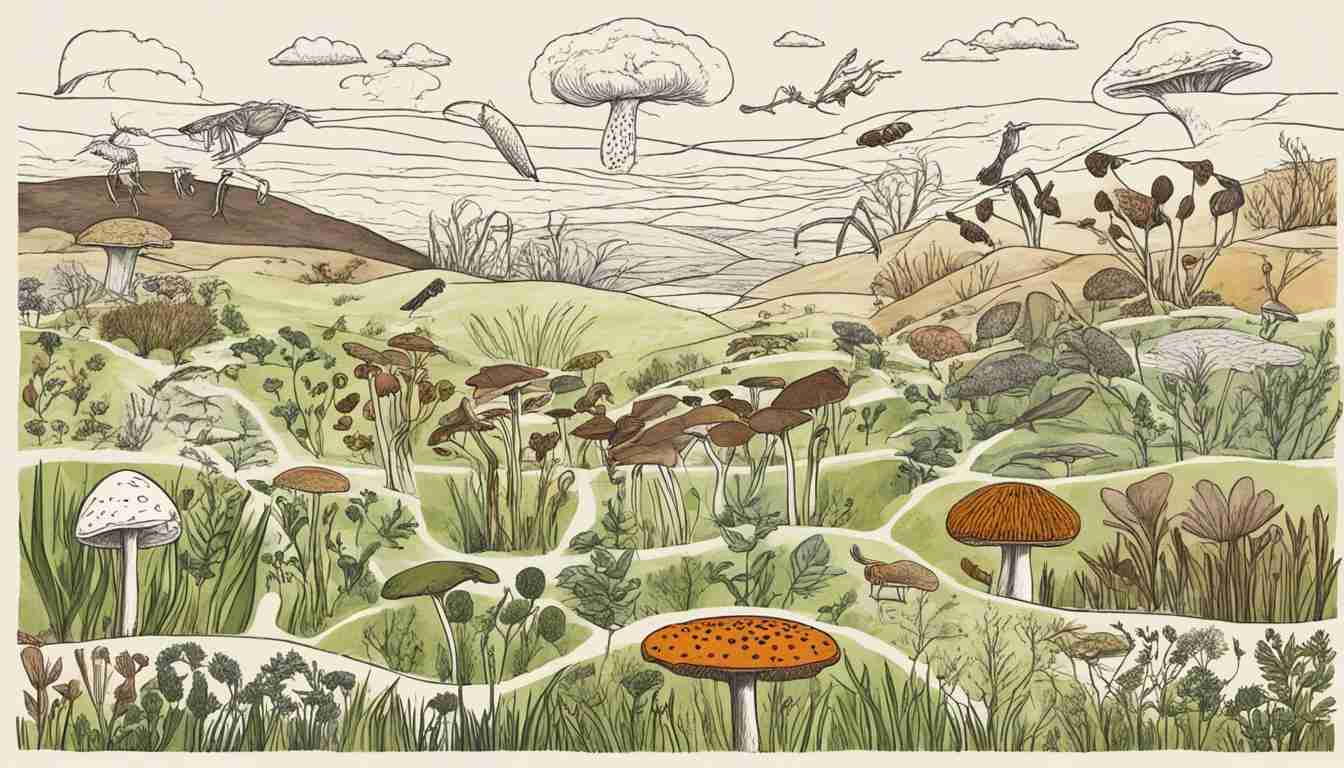
When plants and animals die in a grassland, what happens to their bodies? Do they just sit there forever? The answer is no, thanks to a special group of organisms called decomposers and scavengers. These unsung heroes break down dead matter, returning valuable nutrients to the soil and helping new life grow.
What Are Scavengers?
Scavengers are animals that eat dead animals (carrion) instead of hunting or grazing. They often feed on what’s left after predators have had their share.
Examples of grassland scavengers –
- Vultures – Feed on carcasses using strong stomach acid
- Hyenas – Can scavenge or hunt in packs
- Jackals – Opportunistic feeders that eat leftovers
- Insects – Beetles and ants often pick bones clean
Why scavengers matter –
- Clean up dead animals that could spread disease
- Help speed up decomposition
- Move nutrients back into the food web
What Are Decomposers?
Decomposers are microscopic organisms that break down dead plants, animal waste, and organic material into simpler substances like carbon and nitrogen.
Key decomposers in grasslands –
- Bacteria – Break down waste at the cellular level
- Fungi – Like molds and mushrooms; grow on dead material
- Actinomycetes – A special group of bacteria found in soil
How they help the ecosystem –
- Recycle nutrients back into the soil
- Support plant growth by improving soil fertility
- Maintain the energy cycle by finishing the breakdown process
Decomposition in Action – A Real Example
Let’s say a bison dies in the prairie –
- Vultures arrive first and eat most of the soft tissue.
- Insects like flies and beetles clean up what’s left.
- Bacteria and fungi break down the bones, skin, and waste.
- Nutrients return to the soil and help new grass grow.
- That grass might one day feed another bison, completing the cycle.
This process shows how life and death are connected in nature.
Decomposers vs. Scavengers – What’s the Difference?
Feature | Decomposers | Scavengers |
|---|---|---|
Type of Organism | Microorganisms (fungi, bacteria) | Larger animals (vultures, hyenas) |
What They Eat | Dead plants, animals, waste | Dead animals (carcasses) |
Method | Break down at microscopic level | Physically consume remains |
Final Outcome | Turn material into nutrients | Begin the breakdown process |
Together, they close the loop in the food web.
Key Terms to Know
- Decomposer – Breaks down dead organisms into simple chemicals
- Scavenger – Eats dead animals left behind by predators
- Carrion – The flesh of dead animals
- Nutrient cycle – The way nutrients move through an ecosystem
- Soil fertility – How rich the soil is in nutrients that support plant growth
Energy Flow in a Grassland Food Web
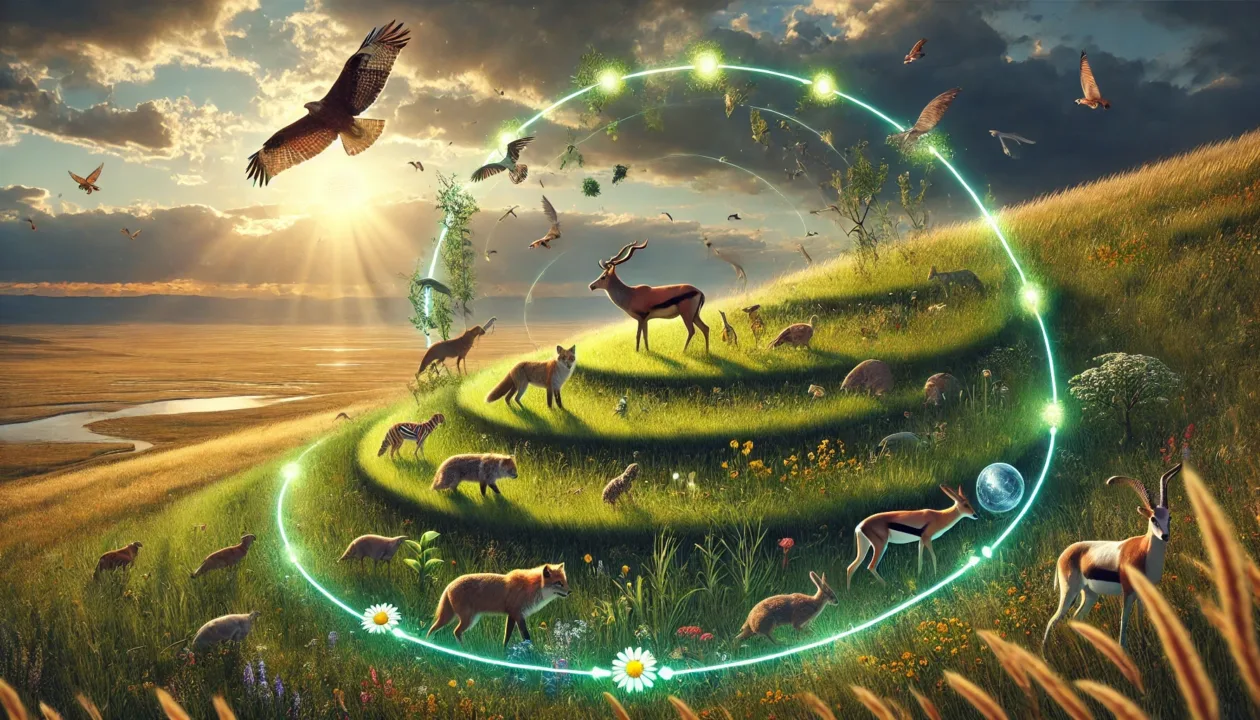
Have you ever wondered how energy moves through an ecosystem? In a grassland, the energy starts with the sun and flows through every plant and animal in a complex system called a food web. Understanding this energy flow helps us see why each organism matters and how the system stays in balance.
Where Does the Energy Come From?
All the energy in a grassland (and almost every other ecosystem) starts with the sun. Plants, or producers, absorb sunlight through their leaves and use a process called photosynthesis to make food. This food contains chemical energy, which is stored in the plant’s tissues.
When an animal eats the plant, it gets some of that energy. Then, another animal might eat that animal, and so on.
Trophic Levels – The Steps in Energy Flow
Energy moves through the food web in steps called trophic levels –
- Producers – Plants like grass and wildflowers that convert sunlight into energy
- Primary consumers – Herbivores like rabbits, antelope, or grasshoppers that eat plants
- Secondary consumers – Carnivores like foxes or snakes that eat herbivores
- Tertiary consumers – Top predators like hawks or lions that eat other carnivores
- Decomposers – Fungi, bacteria, and scavengers that break down dead organisms and return nutrients to the soil
Each level passes less energy than the one before.
The 10% Rule – Why Energy Drops at Each Level
Only about 10% of the energy from one level makes it to the next.
- If 1000 calories are in the grass…
- Only 100 calories go to the rabbit…
- Just 10 calories go to the fox…
- And only 1 calorie goes to the hawk that eats the fox
Why does this happen?
- Animals use most of the energy for movement, digestion, and body heat
- Only a small portion becomes biomass (stored energy that can be passed on)
This energy loss explains why –
- Plants are very abundant
- Herbivores are fewer
- Top predators are the rarest
Energy Pyramids – Visualizing Energy Flow
An energy pyramid is a diagram that shows how energy decreases at each trophic level. The pyramid is wide at the bottom (many plants) and narrow at the top (few predators).
Trophic Level | Example Organism | Energy Available |
|---|---|---|
Tertiary Consumers | Hawk, Lion | ~1 calorie |
Secondary Consumers | Fox, Snake | ~10 calories |
Primary Consumers | Rabbit, Zebra | ~100 calories |
Producers | Grass, Wildflowers | ~1000 calories |
This model helps us visualize why balance is critical – if too many predators exist, there won’t be enough energy to support them.
What Happens When Energy Flow Is Disrupted?
If part of the energy path is broken, like if a species goes extinct or a drought kills many plants, it affects every organism above it.
Examples
- Fewer grasses mean herbivores go hungry → fewer carnivores survive
- Removing a top predator can cause herbivore populations to explode, overgrazing the land
Healthy energy flow = a healthy ecosystem.
Key Terms to Know
- Energy transfer – Movement of energy from one organism to another
- Trophic level – Position in the food chain based on feeding
- Photosynthesis – Process plants use to convert sunlight into energy
- 10% Rule – Only 10% of energy moves up each trophic level
- Energy pyramid – Diagram showing energy loss across levels
Keystone Species in Grasslands

In a grassland, some animals have a bigger impact than others, not because they’re the largest or most powerful, but because everything else depends on them. These species are called keystone species, and without them, the entire food web could change or collapse.
Think of a keystone in an arch, it holds everything together. In an ecosystem, a keystone species does the same thing.
What Is a Keystone Species?
A keystone species is an organism that has a disproportionate effect on its environment. This means that even though it might not be the most numerous or visible species, it plays a critical role in shaping the structure and health of the ecosystem.
Removing a keystone species often causes a trophic cascade, a chain reaction that alters the entire food web.
Examples of Keystone Species in Grasslands
Prairie Dogs (North American Prairies)
- Role – Burrow into the soil, creating homes for other species and mixing nutrients
- Impact – Their burrows help aerate the soil, improve water flow, and provide shelter for snakes, burrowing owls, and insects
- Effect if removed – Soil health declines, and other species lose their habitats
African Elephants (Savannas)
- Role – Knock down trees, preventing forest overgrowth and maintaining open grassland
- Impact – Allow sunlight to reach the ground, helping grasses and shrubs thrive
- Effect if removed – Trees dominate, turning grasslands into woodlands, and grass-feeding animals may decline
Lions (Savannas)
- Role – Apex predator that controls herbivore populations
- Impact – Prevent overgrazing and allow plant regeneration
- Effect if removed – Herbivores may overpopulate, reducing vegetation and leading to soil erosion
Why Keystone Species Matter in Food Webs
- Regulate populations of prey and competitors
- Maintain biodiversity by supporting a variety of species
- Shape habitats through behavior (e.g., digging, grazing, hunting)
- Promote energy flow and balance at every trophic level
Without keystone species, ecosystems may become unbalanced and lose their ability to support life efficiently.
Real-World Analogy
Imagine a school where one student is the group leader who brings everyone together. If they leave, group work becomes disorganized, and no one takes charge. Keystone species are nature’s group leaders, they keep everything working smoothly.
Keystone Species Impact Overview
Keystone Species | Ecosystem Type | Primary Role | Ecosystem Effect |
|---|---|---|---|
Prairie Dog | North American Prairie | Soil aeration, habitat creation | Increases biodiversity, soil health |
Elephant | African Savanna | Controls tree growth | Maintains grassland habitat |
Lion | African Savanna | Top predator | Prevents overgrazing, protects vegetation |
Key Terms to Know
- Keystone species – A species with a critical role in maintaining the ecosystem
- Trophic cascade – A domino effect through the food web caused by the removal of a species
- Ecosystem engineer – An organism that physically changes the environment
- Apex predator – A predator at the top of the food chain with no natural enemies
- Biodiversity – The variety of life in an ecosystem
Adaptations of Grassland Organisms

Grasslands are open, windy, and often dry. There are few trees, but there’s plenty of sun, seasonal rains, and even wildfires. To thrive here, plants and animals must be tough, clever, and highly adapted. Every creature in the grassland has unique traits, called adaptations, that help it survive in this ever-changing environment.
What Are Adaptations?
Adaptations are physical features or behaviors that improve an organism’s chances of survival in a specific environment.
There are three main types –
- Structural adaptations – physical features (e.g. thick fur, long roots)
- Behavioral adaptations – ways of acting (e.g. migrating, burrowing)
- Physiological adaptations – internal processes (e.g. water retention)
In grasslands, survival means coping with heat, wind, limited water, open space, and predators.
Plant Adaptations in Grasslands
Plants in grasslands deal with –
- Droughts
- Grazing animals
- Fires
- Strong winds
Key adaptations
- Deep root systems – to reach underground water and regrow after fire or grazing
- Narrow, flexible leaves – reduce water loss and resist wind damage
- Growth from the base – lets grasses survive even when the tops are eaten
- Fire resistance – many grasses quickly regrow after a burn
- Dormancy – some plants “pause” growth during dry seasons
Examples
- Bluestem grass – grows from underground nodes
- Buffalo grass – survives intense heat and drought
- Acacia trees – store water and have thorns to deter animals
Animal Adaptations in Grasslands
Animals must be able to –
- Spot predators across open land
- Escape quickly
- Survive with limited water
- Handle extreme temperatures
Key adaptations
- Camouflage coloring – to blend in with golden grasses
- Long, powerful legs – for fast running (zebras, antelope)
- Burrowing behavior – to escape predators and extreme heat (prairie dogs, meerkats)
- Efficient water use – many animals get moisture from the plants they eat
- Herding instincts – provide safety in numbers
Examples
- Zebras – stripes confuse predators and help with heat regulation
- Prairie dogs – build underground towns to stay safe and cool
- Snakes and lizards – burrow and are active during cooler times of day
Adaptations in Action – Seasonal Changes
Grasslands often go through wet and dry seasons. Some animals migrate to follow water and food, while others change their behavior.
Examples
- Wildebeest migrate across African savannas in massive herds
- Birds like meadowlarks move between regions depending on the season
- Insects and amphibians may go dormant underground during droughts
Why Adaptations Matter
Without their special traits, grassland organisms would struggle to survive.
These adaptations –
- Help balance the food web
- Allow plants to bounce back after fires or grazing
- Let animals thrive in harsh, open environments
- Show how evolution shapes life over time
Key Terms to Know
- Adaptation – A trait that helps an organism survive
- Structural adaptation – A physical characteristic
- Behavioral adaptation – A learned or instinctual action
- Camouflage – Coloring or patterns that help animals hide
- Drought resistance – The ability to survive with little water
Seasonal Changes and Migration

Grasslands are far from static. Throughout the year, these ecosystems experience seasonal changes, wet and dry periods, temperature shifts, and variations in food and water availability. To survive, many animals have adapted to these changes by migrating, hibernating, or changing their behavior.
Seasonal changes add a dynamic rhythm to the grassland food web, affecting every level from plants to top predators.
Seasonal Patterns in Grasslands
Grasslands around the world have different types of seasons, but most follow a similar pattern.
Temperate Grasslands (like North American prairies)
- Hot summers and cold winters
- Snowfall in winter, with little plant growth
- Spring/summer growth bursts fueled by rain
Tropical Grasslands (Savannas) (like African savannas)
- Wet season – Lush green growth, plenty of water
- Dry season – Scorching heat, limited water, dried grass
These cycles influence the availability of food, water, and shelter, which means organisms must stay flexible to survive.
Animal Migration in Grasslands
Migration is one of the most powerful responses to seasonal change. Animals move across large distances to find better food, water, or breeding conditions.
Famous Grassland Migrations
- Wildebeest (Africa) – Over a million wildebeest migrate across the Serengeti in search of greener pastures.
- Pronghorn antelope (North America) – Travel between summer and winter ranges.
- Birds like meadowlarks and swallows – Migrate between northern grasslands and warmer southern climates.
Why animals migrate
- Avoid harsh temperatures
- Find food and water during dry or cold months
- Give birth or raise young in safer, richer areas
Other Adaptations to Seasonal Change
Not all animals migrate, some adapt their behavior or life cycle instead.
Examples
- Prairie dogs stay in burrows and reduce activity during winter
- Snakes and insects go into brumation (cold-weather dormancy)
- Plants go dormant and drop seeds during dry or cold seasons
- Frogs and toads may burrow underground to avoid drought
These strategies help animals conserve energy and reduce risk during tough times.
How Seasonal Changes Affect the Food Web
When plants stop growing during a dry or cold season –
- Herbivores may migrate or face food shortages
- Carnivores must move with prey or hunt less frequently
- Decomposers may become more active during moist seasons when plant and animal material is abundant
If one part of the web adjusts poorly, it can cause a chain reaction across the ecosystem.
Key Terms to Know
- Migration – The seasonal movement of animals from one region to another
- Dormancy – A period of reduced activity or growth
- Wet season/Dry season – Seasonal periods of rainfall or drought in tropical areas
- Brumation – Dormancy in cold-blooded animals
- Seasonal adaptation – Any change in behavior or physiology triggered by seasons
Regional Case Studies – Prairie vs Savanna
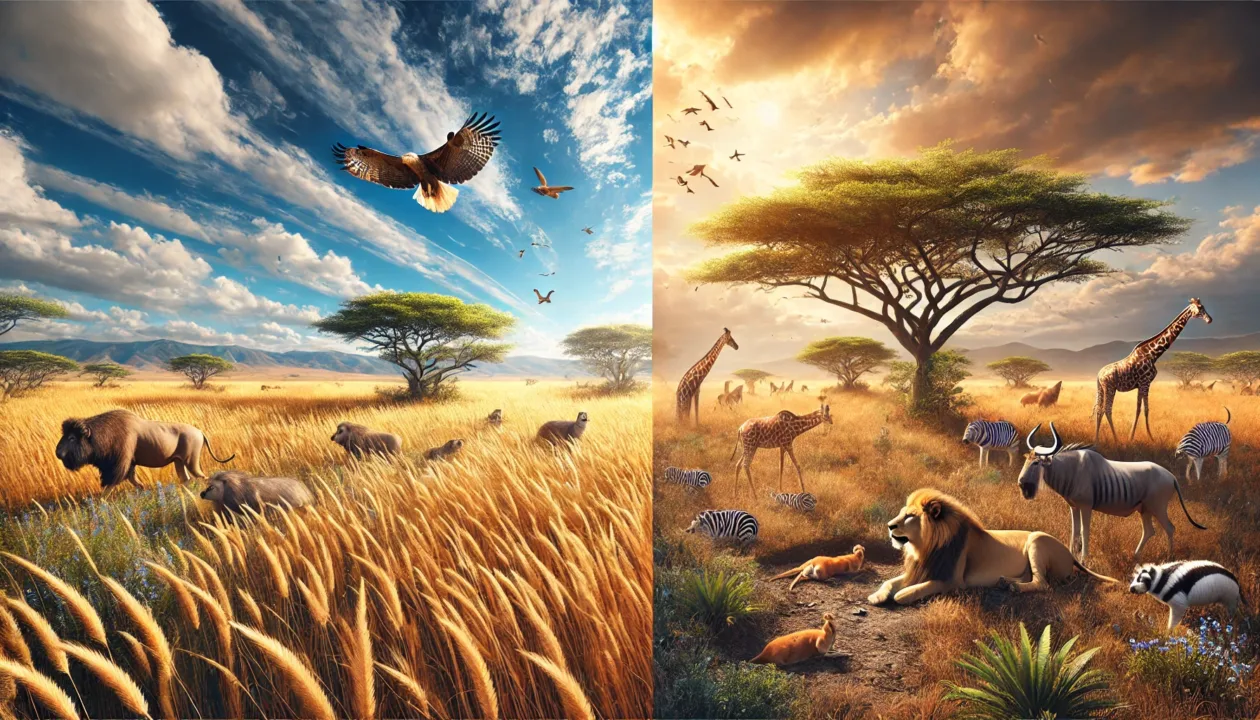
Not all grasslands are the same. While they may share wide open spaces and grassy terrain, grasslands in different parts of the world host very different species, climates, and food webs. In this section, we’ll explore two of the most iconic grasslands on Earth, the North American prairie and the African savanna, to see how regional differences shape life and energy flow.
The North American Prairie
Overview
- Found in the central United States and southern Canada
- Known for rich soil and moderate rainfall
- Divided into tallgrass, mixed-grass, and shortgrass prairie zones
Climate
- Temperate with hot summers and cold winters
- Seasonal rainfall, including occasional droughts and wildfires
Key Species
- Producers – Big bluestem, buffalo grass, switchgrass
- Herbivores – Bison, prairie dogs, grasshoppers, elk
- Carnivores – Coyotes, foxes, hawks, badgers
- Decomposers – Soil bacteria, fungi, insects
Food Web Snapshot
Grass → Grasshopper → Mouse → Hawk Grass → Bison → Wolf → Scavenger beetle
Unique Features
- Prairie dogs act as keystone species through burrowing
- Fire ecology helps maintain grass dominance and reset plant growth cycles
- Formerly home to millions of bison, shaping plant and predator populations
The African Savanna
Overview
- Found across East and Southern Africa, including the Serengeti
- Characterized by grassy plains with scattered trees
Climate
- Tropical with distinct wet and dry seasons
- Warm year-round with dramatic seasonal rainfall shifts
Key Species
- Producers – Red oat grass, acacia trees, baobab
- Herbivores – Zebras, wildebeest, elephants, giraffes
- Carnivores – Lions, cheetahs, hyenas, vultures
- Decomposers – Termites, fungi, bacteria
Food Web Snapshot
Grass → Zebra → Lion → Vultures Acacia → Giraffe → Leopard → Hyena
Unique Features
- Massive animal migrations (e.g., wildebeest)
- Elephants as ecosystem engineers, keeping the landscape open
- Top predators like lions maintain herbivore balance
Prairie vs. Savanna – Key Differences
Feature | North American Prairie | African Savanna |
|---|---|---|
Climate | Temperate (4 seasons) | Tropical (wet/dry seasons) |
Vegetation | Mostly grasses | Grasses + scattered trees |
Main Herbivores | Bison, elk, prairie dogs | Zebras, wildebeest, elephants |
Top Predators | Coyotes, hawks | Lions, cheetahs |
Keystone Species | Prairie dogs, bison | Elephants, lions |
Rainfall Pattern | Seasonal, moderate | Seasonal, more extreme |
Soil Quality | Very fertile | Thin but nutrient-cycled soil |
What These Case Studies Teach Us
Studying prairies and savannas side by side helps us understand –
- How climate shapes ecosystems
- The role of specific species in energy flow and balance
- How different grasslands evolve to support biodiversity
- That no two food webs are exactly alike, even in similar biomes
Each region has its own version of producers, consumers, and decomposers, adapted to the local conditions. The comparison also shows that while grasslands are simple in appearance, they are complex in function.
Key Terms to Know
- Prairie – A temperate grassland found in North America
- Savanna – A tropical grassland with seasonal rainfall and scattered trees
- Ecosystem engineer – An organism that changes the environment
- Fire ecology – The role of fire in maintaining healthy ecosystems
- Biodiversity – The variety of life in a particular habitat
FAQs
What is a grassland food web?
A grassland food web is a complex network of interrelated food chains that illustrates the feeding relationships between different organisms in a grassland ecosystem. It showcases how energy and nutrients flow through the ecosystem, starting from producers (plants) to various levels of consumers (herbivores, carnivores, omnivores) and decomposers.
Which organisms are the primary producers in grassland ecosystems?
In grassland ecosystems, primary producers are mainly grasses, along with other herbaceous (non-woody) plants. These plants convert sunlight into energy through photosynthesis, serving as the foundation for the food web.
What role do herbivores play in grassland food webs?
Herbivores, such as deer, rabbits, and insects, consume plants. They are primary consumers in the grassland food web, transferring energy from the plants (producers) to the higher levels of consumers (carnivores and omnivores).
Can you name some carnivores found in grassland ecosystems?
Carnivores in grassland ecosystems include lions, wolves, birds of prey, and snakes. These animals feed on herbivores and sometimes other carnivores, occupying higher levels in the food web.
What are omnivores, and how do they fit into grassland food webs?
Omnivores, such as certain bird species and small mammals, consume both plant and animal matter. They play a versatile role in grassland food webs, linking primary consumers (herbivores) and secondary consumers (carnivores) by feeding on both.
How do decomposers function within grassland food webs?
Decomposers, including bacteria, fungi, and some insects, break down dead organic matter, returning nutrients to the soil. This process supports plant growth, thus maintaining the cycle of the food web.
What impact do human activities have on grassland food webs?
Human activities, such as agriculture, urbanization, and pollution, can disrupt grassland food webs by altering habitats, reducing biodiversity, and affecting the availability of resources for different organisms.
How does biodiversity affect the stability of grassland food webs?
Higher biodiversity tends to increase the stability of grassland food webs by providing a variety of food sources and habitats, helping the ecosystem to withstand and recover from disturbances.
What are some challenges faced by grassland ecosystems today?
Grassland ecosystems face challenges such as habitat loss, invasive species, climate change, and overgrazing, which can disrupt food webs and threaten biodiversity.
How can grassland food webs be protected and restored?
Protecting and restoring grassland food webs involves conserving natural habitats, promoting sustainable land use practices, restoring native plant species, controlling invasive species, and mitigating the impacts of climate change.
References and Sources
EcoLinc Australia – Grassland Food Webs
Northern Arizona University – Life on the Food Chain
Study.com – The Grassland Food Web – Temperate, African and Tropical