

What Are Abiotic Components?
Imagine walking through a forest. You see trees, animals, insects, and fungi, these are all living things, or what scientists call biotic components. But what about the sunlight streaming through the leaves, the cool breeze, the moist soil, and the clean water flowing through a stream? These are just as important, and they are known as abiotic components.
Definition of Abiotic Components
Abiotic components are the non-living parts of an ecosystem that influence and support life. The term “abiotic” comes from two words –
- “A” meaning “not”
- “Biotic” meaning “living”
So, “abiotic” literally means “not living.”
In every environment, from oceans to deserts, abiotic components help shape the conditions that living organisms depend on to survive and thrive.
Key Examples of Abiotic Components
To better understand abiotic components, let’s look at five key examples that are found in nearly every ecosystem –
- Sunlight
- Provides the energy that plants use for photosynthesis, which supports the entire food chain.
- Water
- Essential for all life; it helps transport nutrients and regulate body temperature in organisms.
- Air (Atmosphere)
- Contains oxygen for animals and carbon dioxide for plants.
- Soil
- A mix of minerals and organic matter that supports plant life and stores water and nutrients.
- Temperature
- Affects where organisms can live; some need warmth, while others thrive in the cold.
Abiotic vs. Biotic – What’s the Difference?
It’s easy to confuse abiotic and biotic factors, but there’s a simple way to remember it –
Abiotic (Non-Living) | Biotic (Living) |
|---|---|
Sunlight | Plants |
Water | Animals |
Temperature | Bacteria |
Soil | Fungi |
Air (Oxygen/CO₂) | Humans |
While abiotic factors don’t grow, reproduce, or eat, they directly affect the way living organisms survive and interact with one another.
Why Are Abiotic Components Important?
Abiotic components set the stage for life. For example –
- In deserts, the hot temperatures and dry air limit which plants and animals can survive.
- In rainforests, abundant sunlight and moisture create the perfect setting for a wide variety of species.
Without the right abiotic conditions, an ecosystem can’t function properly. Even small changes, like a rise in temperature or a decrease in rainfall, can affect the entire food chain.

Why Abiotic Components Matter

At first glance, non-living things like sunlight or rocks might not seem as important as animals or plants in an ecosystem. But in reality, abiotic components are the foundation of life. Without them, ecosystems wouldn’t exist, and neither would we.
Abiotic Components Shape the Environment
Every ecosystem, from a coral reef to a mountaintop, exists because certain abiotic conditions are present. These conditions determine –
- What kinds of plants can grow
- Which animals can survive
- How nutrients move through the system
For example –
- Cacti survive in deserts because they’re adapted to high temperatures and low rainfall.
- Frogs need wet environments with moderate temperatures and freshwater to lay eggs.
In other words, abiotic factors control the rules of the game. They decide who can live where and how ecosystems develop.
Abiotic Factors and the Flow of Energy
Life depends on energy, and the main energy source on Earth is the Sun, an abiotic factor.
Here’s how the flow works –
- Sunlight hits plants.
- Plants use sunlight to make food through photosynthesis.
- Herbivores eat plants.
- Carnivores eat herbivores.
This entire food chain starts with an abiotic factor – light. Without it, there’s no energy to support life.
Nutrient Cycles Depend on Abiotic Factors
Water, air, and soil aren’t just physical stuff, they’re part of cycles that help organisms stay alive –
- Water Cycle – Water evaporates, condenses into clouds, then falls as rain or snow – watering plants and filling rivers.
- Carbon Cycle – Plants absorb carbon dioxide from the air. Animals breathe it out.
- Nitrogen Cycle – Soil contains nitrogen that plants absorb to grow.
These cycles are powered and supported by abiotic components like sunlight, gravity, temperature, and atmospheric gases.
Abiotic Changes Can Cause Big Problems
Even small changes in abiotic factors can throw off the entire balance of life in an area.
- A rise in temperature can lead to the melting of polar ice caps, affecting animals like polar bears.
- Less rainfall can cause droughts, harming crops and drying up rivers.
- Pollution (a human-caused abiotic influence) can damage air and water quality, making it hard for organisms to survive.
That’s why scientists study abiotic components carefully, they’re often the first signs that something is changing in an ecosystem.
Abiotic and Biotic – A Team Effort
Remember – Ecosystems are made of both abiotic and biotic parts. One can’t function without the other.
Think of it like a sports game –
- The players are the living things (biotic).
- The field, weather, and rules are the non-living things (abiotic).
No matter how skilled the players are, they can’t play if the field floods, the lights go out, or there’s no air to breathe.
Quick Recap
- Abiotic components determine which organisms can survive in an environment
- They control the flow of energy and nutrients in ecosystems
- Changes in abiotic conditions can cause major shifts in life patterns
- Ecosystems are a team effort between living and non-living components
The 3 Categories of Abiotic Components

Now that you know abiotic components are the non-living factors that shape life on Earth, it’s time to go deeper. Scientists often organize abiotic components into three main categories to better understand how they work –
- Physical Factors
- Chemical Factors
- Climatic Factors
Let’s break these down one by one, with real-life examples you’ve probably seen in nature or in your science class.
Physical Abiotic Factors
These are the tangible, non-living elements you can usually see or touch. They create the physical environment in which life exists.
Examples include –
- Sunlight – Powers plant growth through photosynthesis
- Soil – Provides nutrients and support for plants
- Water – Vital for hydration and chemical processes
- Air – Needed for breathing and gas exchange
- Rocks and minerals – Contribute to soil formation and structure
Why they matter – Without these physical components, plants wouldn’t grow, animals wouldn’t have water, and habitats like forests, deserts, and rivers couldn’t form.
Chemical Abiotic Factors
These involve chemical elements and compounds that affect how organisms live and interact. Even though you can’t always see them, they’re working behind the scenes every second.
Examples include –
- pH of soil or water – Influences which plants or fish can survive
- Salinity (salt level) – Affects freshwater vs. marine life
- Nutrient levels – Nitrogen, phosphorus, potassium help plants grow
- Oxygen (O₂) and Carbon Dioxide (CO₂) – Used for breathing and photosynthesis
- Mineral content – Essential for cell function and growth
Why they matter – Chemical abiotic factors determine whether an environment is healthy or toxic for life. If oxygen runs low or pH levels become too acidic, many organisms can’t survive.
Climatic Abiotic Factors
These relate to weather and long-term climate patterns that shape ecosystems across seasons or even years.
Examples include –
- Temperature – Controls the range of organisms that can live in a place
- Rainfall – Determines water availability for plants and animals
- Wind – Helps with seed dispersal and weathering of rocks
- Humidity – Affects how animals cool off or stay hydrated
- Sunlight Intensity – Varies by latitude and season
Why they matter – Climatic factors influence where specific ecosystems form, like tundras, rainforests, or deserts, and how plants and animals adapt to them.
How the Categories Work Together
Here’s the key idea – All three abiotic categories interact with each other.
For example –
- A change in climate (like temperature or rainfall) can affect soil moisture (a physical factor).
- That, in turn, can change the chemical makeup of the soil (like pH or nutrients).
So, abiotic components aren’t isolated, they form a complex, interlinked system that helps life survive and adapt.
Category | Examples | Effect on Life |
|---|---|---|
Physical | Water, soil, air, rocks, sunlight | Creates basic habitat structure |
Chemical | pH, oxygen, minerals, nutrients, salinity | Influences growth, survival, and behavior |
Climatic | Temperature, rainfall, humidity, wind, sunlight | Drives seasons, adaptation, and distribution |
Quick Recap
- Abiotic components fall into physical, chemical, and climatic groups
- Each group plays a unique role in supporting ecosystems
- These factors interact and influence each other constantly
- Understanding the categories helps scientists predict how ecosystems will respond to changes
Light as a Factor of Life

When you think about light, you probably imagine sunshine, light bulbs, or maybe even your phone screen. But in the natural world, light is far more than something that helps us see, it’s a powerful abiotic component that drives life on Earth.
Let’s explore how light plays a critical role in the environment and why it matters so much in ecosystems.
Why Light Is an Abiotic Component
Light is a non-living (abiotic) factor that provides energy to living things, especially plants. In ecosystems, sunlight is the primary source of energy for most life forms. It enters the ecosystem through photosynthesis, the process plants use to make their own food.
Without light, there would be –
- No photosynthesis
- No plants
- No animals (because they rely on plants, directly or indirectly)
That’s how important light is – it’s the first link in the food chain.
Light and Photosynthesis
Photosynthesis is the process where plants use sunlight, carbon dioxide, and water to produce food (glucose) and release oxygen.
The formula looks like this –
Sunlight + CO₂ + H₂O → Glucose (C₆H₁₂O₆) + O₂
- Sunlight provides the energy.
- Chlorophyll (a green pigment in leaves) captures the light.
- The plant uses that energy to make sugars, which fuel growth.
So, light is more than just illumination, it’s energy that becomes food.
Light Affects Day/Night Cycles and Behavior
Besides photosynthesis, light also controls the day-night cycle, or circadian rhythm, in both plants and animals.
Here’s how –
- Plants open and close their leaves or flowers based on light.
- Animals sleep, hunt, or migrate depending on daylight hours.
- Humans even have sleep cycles tied to light exposure.
The length and intensity of light throughout the year affects seasonal behaviors like –
- Bird migration
- Tree leaf shedding in fall
- Flower blooming in spring
Light Intensity Varies by Location
Not every place on Earth gets the same amount of sunlight.
Region | Light Intensity | Effect on Life |
|---|---|---|
Equator | High year-round | Dense tropical rainforests thrive |
Temperate zones | Varies by season | Plants and animals adapt to seasonal light |
Polar regions | Low light in winter | Organisms adapt to darkness or hibernate |
This variation means different ecosystems develop in different places based on how much light they receive.
Light in Aquatic Environments
In oceans, rivers, and lakes, light doesn’t travel very far underwater. That’s why most aquatic life is found near the surface.
- The top layer (called the photic zone) gets enough sunlight for photosynthesis.
- Deeper areas, like the aphotic zone, are dark and home to creatures that rely on other energy sources – like chemicals or food falling from above.
Even in water, light determines where life can exist.
Quick Recap
- Light is a major abiotic factor that fuels life through photosynthesis
- It affects plant growth, animal behavior, and seasonal patterns
- Light levels change with location, depth, and time of year
- Different ecosystems exist based on how much light they get
Water and Life Support

Take a moment to think about all the ways you use water every day, drinking, showering, cooking, and even growing food. Now imagine a world without it.
Water isn’t just important for humans, it’s one of the most essential abiotic components for all life on Earth. From tropical rainforests to dry deserts, the availability of water shapes entire ecosystems.
Let’s explore why water is so critical for life, how it moves through the environment, and what happens when it’s missing.
Why Water Is Essential
Water makes up 60 to 70% of the human body and an even larger percentage of some animals and plants. But why is it so vital?
Water is needed for –
- Hydration – Keeps cells functioning properly
- Transport – Moves nutrients and waste in plants and animals
- Temperature regulation – Helps organisms maintain a stable internal environment
- Chemical reactions – Most life processes (like digestion or photosynthesis) need water to occur
Without water, cells dry out, plants wilt, and ecosystems collapse.
Water Cycle – Nature’s Recycling System
Water doesn’t stay in one place. It’s always moving through the environment in a system called the water cycle.
Here are the key steps –
- Evaporation – Water changes from liquid to vapor and rises into the air
- Condensation – Water vapor cools and forms clouds
- Precipitation – Water falls as rain, snow, or hail
- Collection – Water gathers in oceans, rivers, lakes, or soaks into the ground
This cycle ensures that ecosystems keep getting fresh water to support life.
Water and Plant Life
Plants are especially dependent on water. Here’s how they use it –
- Photosynthesis – Water combines with sunlight and carbon dioxide to make food
- Nutrient transport – Water carries minerals from the soil into plant roots
- Turgor pressure – Water helps plants stay upright and strong
Fun Fact – A sunflower can absorb over a liter of water a day from the soil!
Without water, plants can’t survive, and since they form the base of most food chains, that affects every other living organism too.
Water in Aquatic Ecosystems
In ecosystems like rivers, lakes, and oceans, water is the habitat itself.
- Fish, amphibians, and aquatic plants depend on water to live and move
- Water temperature, clarity, and flow affect which species can survive
- Salinity (salt level) determines whether an organism lives in freshwater or marine environments
If water becomes polluted or dries up, entire aquatic ecosystems can collapse.
Water Availability Shapes Ecosystems
Different ecosystems exist based on how much water is available –
Ecosystem | Water Availability | Example Species |
|---|---|---|
Rainforest | Very high | Orchids, jaguars, frogs |
Grassland/Savanna | Moderate | Zebras, lions, grasses |
Desert | Very low | Cacti, lizards, scorpions |
Wetland | High & fluctuating | Alligators, reeds, mosquitoes |
Even small changes in rainfall or river levels can change which organisms live in an area.
Quick Recap
- Water is an essential abiotic component for all forms of life
- It enables chemical reactions, nutrient movement, and temperature control
- The water cycle keeps ecosystems hydrated and balanced
- Different amounts of water create different ecosystems
- Lack of water leads to stress, migration, or even extinction for some species
Soil and Mineral Influence

We often walk over it without a second thought, but soil is one of the most powerful abiotic components on Earth. It may seem like just “dirt,” but it’s actually a complex mixture of minerals, organic matter, air, and water, all of which are essential for life.
In this section, we’ll explore what makes soil so important, how minerals support ecosystems, and why even a small change in soil quality can affect an entire habitat.
What Is Soil?
Soil is not just ground-up rock. It’s a layered system made of –
- Minerals (like calcium, phosphorus, and potassium)
- Organic matter (decomposed plants and animals)
- Water and air (stored in small spaces between particles)
- Microorganisms (tiny life forms that break down waste and help nutrients cycle)
Together, these parts create a living foundation for ecosystems, especially for plant life.
Soil Supports Plant Growth
Most plants can’t grow without soil because it provides –
- Anchorage – Roots hold the plant in place
- Nutrients – Minerals like nitrogen and phosphorus help plants grow
- Water retention – Soil holds moisture for roots to absorb
- Gas exchange – Roots need oxygen from soil air pockets
Healthy soil = healthy plants. And since plants are the base of the food chain, that affects every herbivore and carnivore that follows.
The Role of Minerals in the Ecosystem
Minerals in the soil are natural chemical elements that living organisms need to function properly. These include –
Mineral | Function in Plants |
|---|---|
Nitrogen (N) | Leaf growth, chlorophyll production |
Phosphorus (P) | Root development, energy transfer |
Potassium (K) | Water regulation, resistance to disease |
Calcium (Ca) | Cell wall strength, root health |
Magnesium (Mg) | Central atom in chlorophyll molecules |
Without these minerals, plants can become weak, stunted, or die, leading to a chain reaction in the food web.
Soil Types and Their Impact
Soil isn’t the same everywhere. Different types of soil affect how much water and nutrients plants can absorb.
Soil Type | Texture | Water Holding Ability | Ideal For |
|---|---|---|---|
Clay | Fine, sticky | High | Wetland plants |
Sand | Gritty, loose | Low | Cacti and desert plants |
Loam | Balanced mix | Medium (ideal balance) | Most crops and grasses |
Silt | Smooth, powdery | Medium-High | Floodplains and riverbanks |
The structure and chemistry of the soil help decide what kinds of plants can live in an area – and which animals follow.
Soil pH and Fertility
Soil has a pH level, which measures how acidic or basic it is. Most plants grow best in neutral to slightly acidic soil.
- If soil is too acidic or alkaline, certain minerals become locked away and unavailable to plants.
- Over-farming, pollution, or acid rain can reduce soil fertility and harm ecosystems.
This makes soil management a key part of environmental health and agriculture.
Quick Recap
- Soil is a complex abiotic component that anchors, feeds, and hydrates plants
- It contains essential minerals that support growth and ecosystem health
- Different soil types support different kinds
- Soil pH and quality can limit which organisms can thrive in an area
Climate’s Abiotic Elements
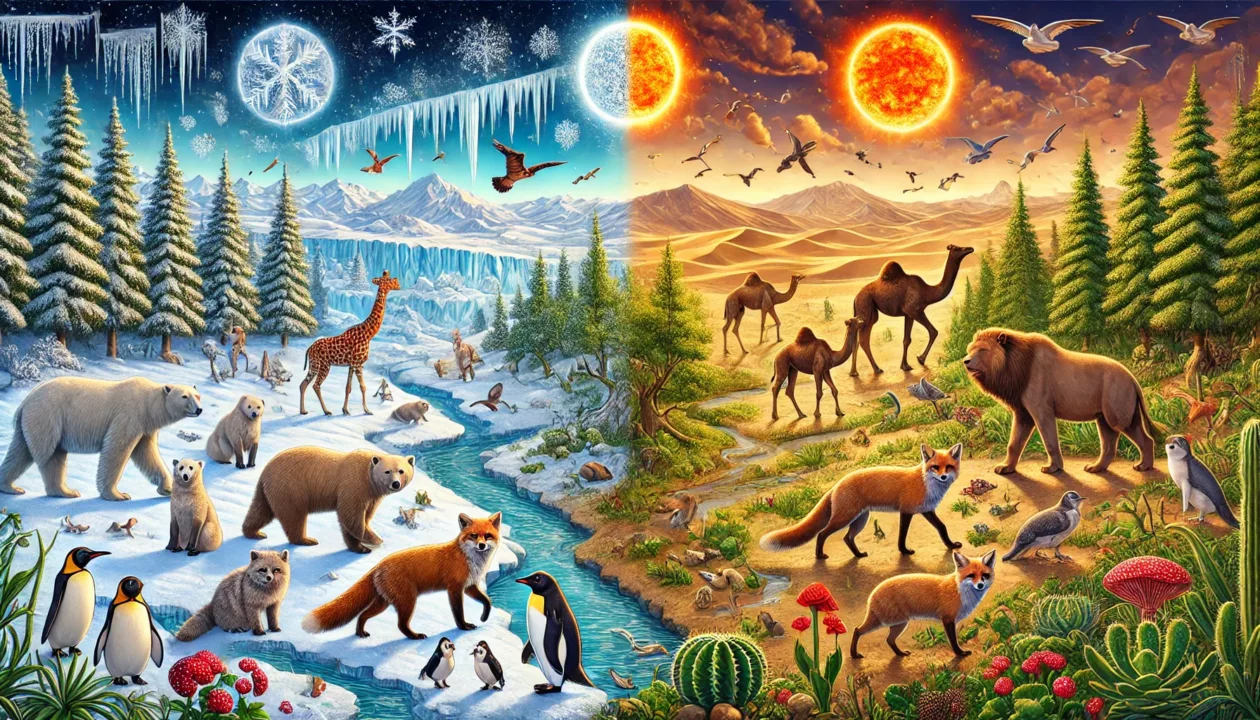
Have you ever noticed how different animals and plants live in different parts of the world? Polar bears thrive in the Arctic, while camels survive in the desert. One big reason for this is climate, a powerful abiotic factor that helps shape every ecosystem on Earth.
In this section, we’ll explore the climatic abiotic elements, how they vary across regions, and why they play such an important role in determining where life can exist.
What Is Climate?
Climate is the long-term pattern of temperature, rainfall, humidity, wind, and sunlight in a particular area. It’s different from weather, which changes daily. Climate stays fairly stable over years or even centuries.
Key climatic abiotic elements include –
- Temperature
- Precipitation (rain and snow)
- Humidity
- Sunlight intensity
- Wind patterns
These elements work together to create climate zones such as deserts, rainforests, tundras, and savannas, each with its own unique conditions.
Temperature – The Great Life Filter
Temperature controls which organisms can survive in an area.
- Cold climates (like the Arctic) support animals with thick fur and antifreeze-like body chemistry.
- Warm climates (like the tropics) support plants and animals that grow and reproduce quickly.
Even slight changes in temperature, just a few degrees, can shift entire ecosystems, affecting where species can live.
Precipitation – Rain and Snow Drive Ecosystems
The amount of rainfall or snowfall an area receives affects –
- Water availability
- Soil moisture
- Vegetation growth
For example –
- Rainforests get over 200 cm of rain per year, supporting dense plant life.
- Deserts may get less than 25 cm per year, with only drought-resistant species able to survive.
Too much rain can lead to flooding, while too little causes droughts, both of which stress ecosystems.
Wind and Air Movement
Wind plays a surprising role in ecosystems –
- Spreads seeds and pollen (especially for plants like dandelions or pine trees)
- Moves clouds and moisture across regions
- Shapes landscapes through erosion in sandy or rocky environments
Wind patterns also help regulate temperature and ocean currents, affecting global climate.
Humidity and Moisture in the Air
Humidity is the amount of water vapor in the air. It affects –
- How plants lose water through their leaves
- How animals stay cool (or overheat)
- The likelihood of rainfall or fog
Tropical regions tend to have high humidity, while deserts have very low humidity. Organisms in each region have unique adaptations to survive their moisture levels.
Sunlight and Seasonal Change
Different parts of the Earth get different amounts of sunlight depending on their latitude (distance from the equator) and the season.
- Near the equator, sunlight is strong and constant year-round.
- Near the poles, sunlight varies greatly – long days in summer, long nights in winter.
This affects everything from plant growth cycles to animal migrations and hibernation patterns.
Climate Zones and Life
Here’s how climatic elements shape different ecosystems –
Climate Zone | Main Abiotic Features | Example Organisms |
|---|---|---|
Rainforest | Warm, high rainfall, high humidity | Orchids, toucans, jaguars |
Desert | Hot/cold, very low rainfall, low humidity | Cacti, lizards, scorpions |
Tundra | Very cold, low precipitation, short summers | Polar bears, moss, arctic foxes |
Grassland | Moderate rain, seasonal temperature changes | Zebras, grasses, elephants |
Temperate Forest | Moderate climate, four seasons | Deer, oaks, squirrels |
- Quick Recap
- Climate is made up of temperature, rainfall, wind, humidity, and sunlight
- These factors influence what lives where and how species survive
- Changes in climate can shift entire ecosystems
- Organisms are adapted to thrive within their climate zone
Abiotic Components in Different Ecosystems

From the icy poles to tropical rainforests, ecosystems around the world are shaped by very different abiotic conditions. These non-living components, like temperature, sunlight, and soil, create unique environments that support specific kinds of life.
In this section, you’ll learn how abiotic components vary between major ecosystems, and how those differences determine which plants, animals, and microorganisms can survive there.
Desert Ecosystems
Abiotic Snapshot –
- Very low precipitation (less than 25 cm per year)
- Extreme temperature shifts (hot days, cold nights)
- Sandy or rocky soil with poor water retention
- Intense sunlight
Ecosystem Effects –
- Only drought-tolerant plants like cacti and succulents can survive
- Animals like lizards and scorpions are adapted to conserve water
- Minimal vegetation = low humidity and fragile food chains
Temperate Forest Ecosystems
Abiotic Snapshot –
- Moderate rainfall and fertile soil
- Four distinct seasons
- Moderate temperatures
- Filtered sunlight under tree canopy
Ecosystem Effects –
- Deciduous trees (like oak and maple) lose leaves in winter
- Rich soil supports a wide range of herbivores and carnivores
- Seasonal changes influence behaviors like migration and hibernation
Tropical Rainforest Ecosystems
Abiotic Snapshot –
- Very high rainfall (over 200 cm annually)
- Warm temperatures year-round
- High humidity and intense sunlight
- Shallow, nutrient-poor soil due to rapid decomposition
Ecosystem Effects –
- Dense, multi-layered vegetation – canopy, understory, forest floor
- High biodiversity – home to millions of species
- Organisms adapted to constant warmth and moisture
Grassland Ecosystems (Savannas & Prairies)
Abiotic Snapshot –
- Seasonal rainfall (often in bursts)
- Frequent droughts and fires
- Windy, open terrain
- Nutrient-rich soil
Ecosystem Effects –
- Dominated by grasses and scattered trees
- Home to large herbivores (e.g., bison, zebras) and fast predators
- Fire and grazing keep tree growth in check
Tundra Ecosystems
Abiotic Snapshot –
- Extremely cold temperatures
- Short growing seasons
- Permafrost (frozen subsoil)
- Low precipitation (like a cold desert)
Ecosystem Effects –
- Low-growing plants like moss and lichens
- Animals with thick fur and fat layers (e.g., caribou, arctic fox)
- Many species migrate or hibernate to survive
Aquatic Ecosystems (Freshwater & Marine)
Abiotic Snapshot –
- Salinity levels (freshwater vs. saltwater)
- Temperature (varies with depth and location)
- Light availability (limited in deep water)
- Water pressure and oxygen content
Ecosystem Effects –
- Sunlight supports photosynthetic algae near the surface
- Deep-sea organisms use bioluminescence or feed on falling matter
- Species adapted to either freshwater (e.g., lakes, rivers) or saltwater (e.g., oceans, coral reefs)
Ecosystem Comparison Table
Ecosystem | Main Abiotic Factors | Adaptations |
|---|---|---|
Desert | Heat, sunlight, dry soil, low rainfall | Water storage, nocturnal behavior |
Rainforest | High rainfall, warm temps, humidity, low soil nutrients | Canopy layers, broad leaves, fast growth |
Temperate Forest | Moderate rain/temp, seasonal change, rich soil | Leaf loss, hibernation, seasonal behaviors |
Grassland | Seasonal drought, wind, fire, nutrient-rich soil | Fire resistance, grazing adaptation |
Tundra | Cold, short summer, permafrost | Migration, insulation, compact growth |
Aquatic | Salinity, water temp, light/depth, dissolved oxygen | Gills, streamlined bodies, light sensitivity |
Why These Differences Matter
Different abiotic conditions create different environmental pressures, which lead to –
- Unique adaptations in plants and animals
- Biodiversity hotspots in favorable conditions
- Vulnerability in extreme or changing climates
By understanding how abiotic factors vary across ecosystems, scientists can better predict –
- How climate change will affect species
- Which environments are most at risk
- How to conserve biodiversity in the face of change
Quick Recap
- Each ecosystem has its own unique set of abiotic components
- These factors shape who survives and how
- Ecosystem health depends on the balance of these non-living elements
- Understanding abiotic variation helps us protect Earth’s diversity
Human Impact on Abiotic Balance
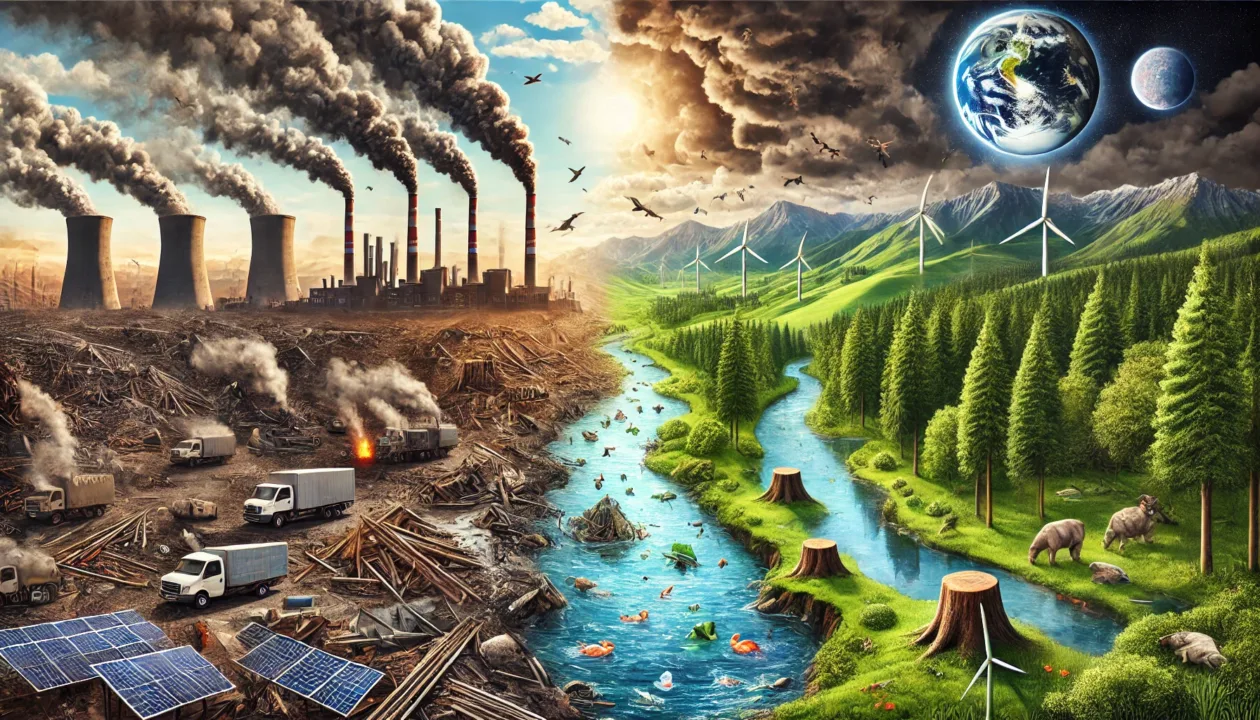
So far, we’ve learned how abiotic factors like sunlight, water, soil, and temperature shape life on Earth. But what happens when humans start to change those non-living components?
In this section, we’ll explore how human activities are affecting abiotic components, and why that matters for ecosystems, climate, and the future of our planet.
Climate Change – Warming the Planet
One of the biggest human impacts on abiotic factors is climate change.
Burning fossil fuels like coal, oil, and gas releases greenhouse gases (such as carbon dioxide, CO₂) into the atmosphere. These gases trap heat, causing the Earth’s temperature to rise, a process known as global warming.
Abiotic effects include –
- Rising global temperatures
- Melting glaciers and permafrost
- More heatwaves and droughts
- Changing rainfall patterns
These changes shift abiotic conditions so quickly that many organisms can’t adapt in time.
Air and Water Pollution
Factories, cars, and agriculture release pollutants into the air and water, affecting abiotic elements like air quality and water chemistry.
Common pollutants –
- Carbon monoxide (CO) – Reduces air’s oxygen-carrying ability
- Nitrogen and phosphorus – Lead to algae overgrowth in water (called eutrophication)
- Acid rain – Caused by sulfur dioxide and nitrogen oxides mixing with water vapor
Abiotic consequences –
- Lower oxygen levels in water, harming fish
- Changing pH levels in soil and water
- Reduced sunlight penetration in lakes from murky water
Soil Degradation and Erosion
Soil, a crucial abiotic factor, is easily damaged by human activities like –
- Over-farming – Removes nutrients from the soil
- Deforestation – Leaves soil exposed to erosion
- Pesticide use – Harms soil organisms that support nutrient cycles
As a result, soil loses its ability to support crops and native plants, leading to land degradation and sometimes desertification (turning fertile land into desert).
Urbanization – Changing the Abiotic Landscape
When humans build cities, roads, and factories, they dramatically alter abiotic conditions.
Examples –
- Impermeable surfaces (like concrete) stop water from soaking into the ground
- Urban heat islands make cities hotter than surrounding areas
- Artificial lighting disrupts natural light cycles for animals and plants
All of these changes impact how energy flows, how water moves, and where life can thrive.
Ecosystem Imbalance
When abiotic factors are altered too quickly or too drastically, ecosystems can become unbalanced.
- Native species may leave or die out
- Invasive species may move in
- Food chains can collapse
- Biodiversity can drop sharply
In some cases, ecosystems may reach a tipping point – a stage where recovery becomes very difficult or even impossible without human intervention.
What Can We Do?
Even though humans are causing these changes, we can also be part of the solution.
Ways to reduce our impact on abiotic components –
- Use renewable energy (like solar or wind)
- Reduce waste and pollution
- Protect natural habitats
- Plant trees to support soil and air quality
- Conserve water and reduce overuse
Every action that helps protect the environment also helps keep abiotic factors in balance – and ecosystems healthy.
Quick Recap
- Humans are changing abiotic factors like temperature, soil, air, and water
- These changes lead to ecosystem stress and biodiversity loss
- Pollution, urbanization, and climate change all impact abiotic balance
- We can help by conserving resources, reducing pollution, and protecting ecosystems
Abiotic Stress and Organism Adaptation

What happens when the environment becomes too hot, too dry, too salty, or otherwise too extreme for most organisms to handle? This is what scientists call abiotic stress, when non-living factors in an ecosystem reach levels that challenge survival.
In this section, you’ll learn what abiotic stress is, how it affects living things, and how some organisms have evolved amazing adaptations to survive in even the harshest conditions.
What Is Abiotic Stress?
Abiotic stress refers to negative effects on living organisms caused by extreme or harmful non-living environmental factors.
These stressors may include –
- Extreme temperatures (hot or cold)
- Drought (lack of water)
- High salinity (too much salt)
- Flooding or waterlogging
- High winds or radiation
- Pollution (chemical or heavy metal exposure)
When abiotic conditions become severe, they can limit growth, damage cells, or even kill organisms that aren’t adapted to survive them.
How Do Plants Respond to Abiotic Stress?
Plants can’t run away from danger, so they’ve developed unique ways to survive abiotic stress where they grow.
Examples of Plant Adaptations –
- Drought resistance – Cacti have thick stems to store water and spines instead of leaves to reduce water loss.
- Salt tolerance – Mangroves filter salt through their roots and secrete it from their leaves.
- Cold resistance – Alpine plants grow low to the ground and have small, waxy leaves to protect from frost.
- Flood adaptation – Rice plants have air-filled stems that help them survive in waterlogged fields.
These strategies help plants survive and reproduce, even in environments that would kill most species.
How Do Animals Adapt to Abiotic Stress?
Animals face abiotic challenges too, especially in extreme habitats like deserts, oceans, or polar regions.
Examples of Animal Adaptations –
- Heat resistance – Camels store fat in their humps and can survive without water for days.
- Cold adaptation – Polar bears have thick fur, a layer of fat, and black skin to absorb heat.
- Water conservation – Kangaroo rats produce highly concentrated urine and don’t need to drink water.
- High altitude survival – Yaks and llamas have large lungs and blood that carries more oxygen.
These physical and behavioral traits help animals conserve energy, regulate body temperature, or find scarce resources in tough environments.
Stress Responses Inside the Body
Even at the microscopic level, cells react to abiotic stress –
- Heat shock proteins – Protect cell structures when temperatures rise too high
- Osmoregulation – Helps organisms maintain the right water and salt balance
- Antioxidants – Protect against damage from UV light or pollutants
Some plants and animals even switch on specific genes during stress, helping them respond more quickly the next time.
Abiotic Stress in Agriculture
Abiotic stress isn’t just a wild nature issue, it’s a major problem in farming.
Examples –
- Droughts reduce crop yields
- Salty soil makes it harder for plants to absorb water
- Extreme heat damages plant tissues or delays growth
To fix this, scientists are developing stress-resistant crop varieties (like drought-tolerant corn or salt-tolerant rice) using selective breeding and genetic engineering.
Quick Recap
- Abiotic stress is when non-living environmental factors harm living things
- Organisms respond with physical, behavioral, or biological adaptations
- Plants and animals have evolved to survive extreme heat, cold, dryness, and salinity
- Abiotic stress affects natural ecosystems and agriculture
- Science and innovation help humans manage and adapt to these challenges too
Abiotic Components in Laboratory vs. Natural Settings
Have you ever done a science experiment in class with plants, soil, or water? If so, you were working in a controlled environment, one where scientists (or students!) can manage the abiotic components to test how life reacts under different conditions.
But real ecosystems don’t come with control buttons. Nature is complex, messy, and full of interacting forces. So how do abiotic components behave differently in the lab vs. the natural world?
Let’s explore the key differences, similarities, and why both settings are important for understanding ecology.
What Is a Controlled Environment?
In a lab or classroom, scientists use controlled environments to study one or two variables at a time while keeping others constant. This allows them to understand cause and effect.
Controlled abiotic factors might include –
- Temperature (set using incubators)
- Light (from lamps or LED setups)
- Water levels (measured and added precisely)
- pH or salinity (adjusted with chemicals)
- Nutrients (added in fixed amounts)
By limiting outside influences, researchers can isolate one factor, like how much light affects plant growth, without interference from other variables like wind or pests.
What Happens in Natural Ecosystems?
In nature, abiotic factors are unpredictable and interconnected –
- Rainfall can change soil pH
- Temperature affects water evaporation
- Wind impacts moisture levels and seed spread
- Sunlight varies with time of day, clouds, and seasons
These interactions make real-world ecosystems more complex and realistic, but also harder to study with perfect accuracy.
Lab vs. Nature – Key Differences
Aspect | Lab Environment | Natural Ecosystem |
|---|---|---|
Control of variables | High control – one factor changed at a time | Low control – many factors change at once |
Reproducibility | Easy to repeat exactly | Hard to replicate conditions |
Complexity | Simplified and focused | Highly complex with multiple interactions |
Realism | Artificial setup | True-to-life conditions |
Observation Time | Short-term (days to weeks) | Long-term (seasons to years) |
Why Use Laboratory Studies?
- To test specific hypotheses (e.g., “Does temperature affect seed germination?”)
- To train students and researchers in scientific method
- To develop new technologies, like drought-resistant crops
- To simulate future conditions like higher CO₂ levels or acid rain
Labs are ideal for controlled experimentation, where you want to see how one abiotic factor impacts life.
Why Study Natural Ecosystems?
- To see how abiotic and biotic factors interact in the real world
- To track environmental changes over time
- To observe behavior and adaptation in native habitats
- To learn from biodiversity and natural complexity
Field studies help us understand how multiple abiotic factors (temperature, water, wind, light) work together to shape ecosystems.
What’s the Best Approach?
Both lab and natural studies are important! Scientists often –
- Start in the lab to test an idea under controlled conditions
- Follow up in nature to see if the results hold true in real ecosystems
This method helps balance precision and real-world relevance.
Quick Recap
- Lab environments control abiotic factors to test ideas clearly
- Natural ecosystems are uncontrolled and more realistic
- Scientists use both settings to understand how life reacts to non-living conditions
- Studying abiotic components in different settings helps us solve real-world challenges
FAQ’s
What are abiotic components in an ecosystem?
Abiotic components are the non-living physical and chemical elements of an environment that influence living organisms and the functioning of ecosystems. These include factors such as sunlight, temperature, water, air, soil, and minerals.
How do abiotic components differ from biotic components?
Abiotic components are non-living elements like water, soil, and atmosphere, whereas biotic components are living things within an ecosystem, such as plants, animals, and bacteria.
Why are abiotic components important to ecosystems?
Abiotic components shape ecosystems by influencing the growth, survival, and reproduction of organisms. For example, sunlight provides energy for photosynthesis, water is essential for life processes, and soil provides nutrients for plant growth.
Can abiotic factors affect species distribution?
Yes, abiotic factors like temperature, water availability, and soil type can create boundaries that determine where species can survive, thereby influencing their distribution within an ecosystem.
How do abiotic components interact with biotic components?
Abiotic components provide the necessary conditions and resources for biotic components to thrive. For instance, plants (biotic) require sunlight, water, and nutrients (abiotic) to perform photosynthesis and grow.
What role does climate play as an abiotic component?
Climate, encompassing temperature and precipitation patterns, is a key abiotic component that influences the types of organisms that can exist in an ecosystem and how they function.
Are human activities considered abiotic components?
No, human activities are not considered abiotic components; however, they can alter abiotic factors. For example, pollution can change water chemistry, and deforestation can affect soil composition and climate.
How do abiotic components vary between terrestrial and aquatic ecosystems?
In terrestrial ecosystems, abiotic components include factors like climate, soil type, and sunlight availability. In aquatic ecosystems, abiotic factors encompass water chemistry, light penetration, salinity, and pressure.
References and Sources