

The circular economy is an economic model that eliminates waste and keeps resources in use through continuous cycles of reuse, repair, refurbishment, and recycling. Unlike the traditional linear economy – which follows a “take-make-dispose” trajectory – the circular economy is regenerative by design, aiming to decouple economic growth from finite resource consumption.
A useful analogy is nature’s own systems: leaves fall, decompose, and nourish the soil – fueling new growth. This waste-as-resource principle mirrors the circular economy’s goal: creating closed resource loops where materials flow continuously through the system, rather than becoming pollutants or landfill.
At the heart of this model lies systems thinking, a holistic approach that considers the interdependence of production, consumption, and waste management. As promoted by the Ellen MacArthur Foundation, the circular economy supports a cradle-to-cradle philosophy, where products are designed for disassembly and regeneration, not obsolescence.
Key characteristics of the circular economy include:
- Designing out waste and pollution from the start
- Keeping products and materials in use for as long as possible
- Regenerating natural systems by returning valuable nutrients to the biosphere
This model addresses resource scarcity, promotes long-term sustainability, and redefines economic systems to prioritize efficiency, resilience, and reduced environmental impact. The transition from a linear to a circular model is central to building a sustainable economy – one capable of delivering growth while preserving the planet for future generations.

Evolution of Circular Thinking: From Theory to Framework

The circular economy originated from decades of interdisciplinary thought, combining systems theory, ecological science, and sustainable design into a structured framework for regenerative growth. Its foundations trace back to early critiques of linear economic models and the finite nature of Earth’s resources.
One of the earliest voices was Kenneth Boulding, who introduced the concept of a “closed economy” in his 1966 essay The Economics of the Coming Spaceship Earth. He contrasted an “open” (linear) economy with a “closed-loop” system, where waste must be eliminated and resources continually reused – an idea central to modern circular thinking.
In the 1970s, Donella Meadows, lead author of The Limits to Growth, advanced systems theory by modeling the Earth’s ecological and economic systems as interdependent feedback loops. This systems-based perspective later became essential in understanding the complexity of circular economies.
Industrial Ecology emerged in the 1980s as a field studying how industrial systems can mimic natural ecosystems. This inspired the zero waste philosophy, which aimed to reduce environmental impact by designing production systems where outputs from one process serve as inputs for another.
The 2002 publication of Cradle to Cradle: Remaking the Way We Make Things by William McDonough and Michael Braungart marked a major milestone. The Cradle to Cradle framework emphasized regenerative design – products should be created for continuous reuse, not disposal – solidifying a design-first approach to circularity.

Further expanding circular thinking, Biomimicry, popularized by Janine Benyus, promoted learning from nature’s time-tested strategies to inform sustainable innovation. This inspired the performance economy model, where access and longevity replace ownership and disposability.
More recently, economist Kate Raworth introduced Doughnut Economics, visualizing a sustainable economy as operating between a social foundation and an ecological ceiling. Her framework complements circularity by defining safe and just operating spaces for humanity within planetary limits.
Today’s circular economy integrates these foundational ideas into a coherent strategy guided by closed-loop thinking, regenerative design, and systems integration. The evolution from early theory to structured frameworks reflects a growing recognition that long-term prosperity depends on embedding circularity into the core of economic development.
Circular vs. Linear: Systems Comparison

The key difference between circular and linear economies lies in how each system handles materials, value, and waste throughout a product’s lifecycle. A linear economy follows a straight path: resource extraction → production → consumption → disposal, resulting in continuous value loss, resource inefficiency, and growing landfill dependency.
In contrast, a circular economy is built on materials flow loops, where resources are maintained at their highest utility through reuse, refurbishment, recycling, and regenerative practices. This structure preserves value, reduces environmental impact, and minimizes the need for virgin resource inputs.
📊 Structural Comparison: Linear vs. Circular Economy
Attribute | Linear Economy | Circular Economy |
|---|---|---|
Model Type | Throughput economy (take-make-waste) | Closed-loop system |
Material Flow | One-way (extraction → landfill) | Circular (reuse → regenerate → recycle) |
End-of-Life Handling | Discarded as end-of-life waste | Re-integrated as input or secondary resource |
Resource Use | High dependency on extraction | Emphasizes resource decoupling and recovery |
Value Retention | Lost post-consumption | Extended through multiple lifecycles |
Environmental Impact | High emissions, pollution, and waste | Reduced carbon footprint and ecological impact |
Visual Model Summary
- Linear Input-Output System: Input (Raw materials) → Output (Products) → Waste (Landfill, Emissions)
- Circular Input-Output System: Input (Reused/Recycled materials) → Output (Products) → Return Loop (Recovery, Repair, Compost)
Lifecycle mapping in circular systems focuses on eliminating end-of-life waste by designing for durability, disassembly, and adaptability. By contrast, linear models lock in extraction dependency, where short product lifespans create a cycle of depletion and disposal.
The throughput economy inherent in linear systems not only wastes resources but also incurs economic costs through lost materials, pollution control, and inefficient logistics. Circular systems counter this by retaining embedded value, optimizing logistics, and fostering sustainable system models.
Principles of the Circular Economy

The circular economy is guided by three core principles: design out waste and pollution, keep products and materials in use, and regenerate natural systems. These principles transform how we design, produce, and interact with goods – shifting from linear consumption to sustainable, value-preserving cycles.
Design Out Waste and Pollution
Circular design begins with eco-design strategies that prevent waste at the source. Products are engineered for durability, modularity, and disassembly, allowing parts to be easily replaced, reused, or upgraded. By integrating biomimicry, designers mimic nature’s efficiency – creating systems where every output becomes a useful input elsewhere.
Key strategies:
- Minimize toxic inputs and CO₂ emissions
- Avoid planned obsolescence
- Use materials with low environmental impact and high recyclability
Keep Products and Materials in Use
A circular product lifecycle extends the useful life of materials through reuse, repair, remanufacturing, and refurbishment. This closed-loop innovation maintains economic value within the system, reducing the need for virgin resource extraction.
Examples:
- Modular electronics that allow component upgrades
- Repairable appliances with standard parts
- Product-as-a-service models (e.g. leased lighting or tires)
By preserving materials in circulation, businesses increase resource efficiency while consumers benefit from longer-lasting, serviceable goods.
Regenerate Natural Systems
Instead of simply minimizing harm, circular systems actively regenerate ecosystems. This principle draws from regenerative processes in agriculture, energy, and materials to restore biodiversity, enrich soil, and absorb carbon.
Regenerative strategies include:
- Composting organic waste to restore nutrients to the soil
- Renewable energy adoption in production processes
- Using biomaterials that naturally degrade or replenish resources
Circular Lifecycle Snapshot
- Design phase: Focus on sustainability, modularity, and non-toxic inputs
- Use phase: Enable reuse, repair, and upgrades
- Post-use phase: Prioritize recovery, remanufacturing, and biological cycling
Together, these principles offer a scalable framework for design for sustainability, building products and systems that support economic, environmental, and social resilience.
Environmental and Climate Impact

The circular economy significantly reduces environmental harm by lowering greenhouse gas (GHG) emissions, cutting waste, and conserving natural resources – making it a critical strategy for climate resilience and sustainability. By redesigning material flows and product lifecycles, circular systems minimize the ecological footprint of human activity.
Reduced Greenhouse Gas Emissions
Circular models reduce lifecycle emissions by limiting the need for raw material extraction, energy-intensive manufacturing, and waste incineration. According to the Ellen MacArthur Foundation, circular strategies could cut global GHG emissions by 9.3 billion tonnes annually by 2050, or about 45% of emissions from production-based sectors.
Examples:
- Material reuse and recycling lower the carbon footprint of production
- Eco-design and modularity reduce emissions from new manufacturing
- Remanufacturing uses up to 90% less energy than producing from virgin inputs
Waste Diversion and Pollution Reduction
Circular systems prevent waste through landfill diversion and the recovery of materials for continuous use. Instead of sending products to landfills, materials are recirculated, reducing pollution from incineration, leaching, and uncontrolled decomposition.
Impact areas:
- Reduced ocean plastic pollution through better product end-of-life design
- Fewer landfills and toxic waste sites
- Support for zero-waste cities and waste-free manufacturing zones
Conservation of Natural Resources
Circularity addresses resource depletion by decoupling economic growth from raw material use. By keeping materials in active use, circular systems conserve biodiversity and reduce the pressure on forests, water sources, and mineral deposits.
Benefits include:
- Sustainable materials replacing finite or high-impact ones
- Lower deforestation and mining activity
- Protection of ecosystem services and biodiversity hotspots
Climate Resilience and Ecosystem Recovery
A circular economy enhances climate resilience by localizing supply chains, reducing dependency on volatile raw materials, and promoting regenerative practices that heal natural systems.
Regenerative impact:
- Composting replenishes soils and sequesters carbon
- Urban farming and biological cycles reduce food system emissions
- Circular construction limits urban heat island effects and emissions
Circular models offer measurable carbon-saving potential, significant pollution reduction, and scalable solutions for achieving net-zero targets. They form the foundation of a future-ready, eco-economy aligned with global climate goals.
Industry Case Studies: Construction, Fashion, Electronics

Circular economy principles are actively reshaping high-impact industries such as construction, fashion, and electronics through closed-loop innovations, material reuse, and sustainable design. These sector-specific case studies illustrate how circular strategies reduce waste, conserve resources, and improve economic efficiency at scale.
Construction: Circular Architecture and Material Reuse
The construction industry accounts for nearly 40% of global material use and 33% of waste generation. Circular strategies like deconstruction, modular design, and material reuse are transforming the built environment.
Key practices:
- Circular architecture focuses on design-for-disassembly, enabling building components to be removed, reused, or recycled
- Component reuse (e.g., steel beams, bricks, timber) reduces embedded carbon
- Green building certifications (e.g., BREEAM, LEED) now reward circular material flows
Example: The Madaster platform in the Netherlands creates “material passports” for buildings, cataloging components for future reuse, boosting traceability, and reducing demolition waste.
Fashion: Circular Design and Textile Recycling
The fashion sector produces over 92 million tonnes of textile waste annually. Fast fashion’s linear model – produce, wear, dispose – is being challenged by circular fashion systems that promote textile recycling, repair, and product-as-a-service models.
Key innovations:
- Textile recycling technologies recover cotton, polyester, and blended fibers
- Brands adopt design-for-repair and modular garments
- Platforms like The Renewal Workshop enable garment refurbishment and resale
Example: Swedish company Renewcell converts worn-out cotton garments into Circulose®, a biodegradable material used to produce new textiles – eliminating the need for virgin cotton.
Electronics: E-Waste Recovery and Repairability
The electronics industry generates over 50 million tonnes of e-waste annually, much of it unrecycled. Circular electronics emphasize design for repairability, remanufacturing, and component recovery to reduce environmental and economic losses.
Key practices:
- Modular devices (e.g., Fairphone) enable easy e-product repairability
- Reverse logistics systems collect, refurbish, and redistribute used devices
- E-waste recycling hubs extract rare metals and valuable materials for reuse
Example: Apple’s Daisy robot disassembles 23 different iPhone models, recovering components like lithium, cobalt, and rare earth elements – supporting a closed-loop supply chain.
Across construction, fashion, and electronics, circular economy models are driving industry innovation by reducing waste, extending product lifecycles, and maximizing resource efficiency.
Digital Technologies Enabling Circular Models

Digital technologies are essential enablers of the circular economy, providing the tools to track materials, optimize resource use, and maintain closed-loop systems at scale. As part of the Industry 4.0 revolution, innovations like IoT, AI, and blockchain bring real-time intelligence and automation to circular strategies across industries.
IoT and Sensor Networks: Real-Time Monitoring and Resource Tracking
Internet of Things (IoT) devices and sensor networks provide real-time data on product usage, condition, and location. These systems enable product tracking across lifecycles and inform smart resource planning for reuse, maintenance, or recycling.
Use cases:
- Sensors in industrial equipment monitor wear and trigger proactive maintenance
- Smart bins track fill levels and waste types for optimized waste diversion
- Asset tagging helps manage and recover components in circular supply chains
AI and Predictive Analytics: Optimization Across Lifecycles
Artificial Intelligence (AI) and predictive analytics power circular data analytics, improving decision-making at every stage of the product lifecycle. AI enables forecasting of material needs, predictive maintenance, and waste minimization through intelligent design and process adjustments.
Applications:
- AI-driven platforms like Rheaply match surplus materials with demand in real-time
- Digital twins simulate products and processes, supporting eco-design and remanufacturing
- Predictive models optimize reverse logistics for used products and components
Blockchain: Traceability and Transparency
Blockchain technology ensures secure, immutable tracking of material flows, creating traceability across supply chains. This supports circular compliance, prevents fraud, and enables customers to verify the origin, composition, and circular status of products.
Examples:
- Product passports on blockchain document component origins, repair history, and recyclability
- Smart contracts automate end-of-life recovery and material returns
- Provenance platforms enable circular certification of sustainable materials
Integrated Platforms: Circular Intelligence Systems
Advanced platforms integrate IoT, AI, and blockchain to manage circular operations holistically. These systems provide lifecycle monitoring, enable modular design feedback loops, and facilitate AI optimization for real-time circular performance.
Example:
- The Circularise platform uses blockchain and digital twins to provide supply chain transparency and material traceability across industries like plastics, automotive, and electronics.
Smart circular systems rely on digital infrastructure to close material loops, reduce waste, and support tech-enabled sustainability. These technologies form the digital backbone of scalable, data-driven circular economies.
Circular Business Models & Value Creation

Circular business models generate economic value by shifting away from single-use transactions toward service-based, resource-efficient systems that retain and recirculate value. These models transform how products are accessed, used, and monetized – extending lifecycles while aligning profitability with sustainability.
Product-as-a-Service (PaaS)
Product-as-a-Service models replace ownership with access, where customers pay for the performance or utility of a product rather than buying it outright. This incentivizes producers to design for durability, repairability, and reuse – driving long-term value retention.
Examples:
- Michelin offers tires as a service based on mileage
- Philips Lighting leases light-as-a-service to commercial clients
- Usage-based billing models in software and appliances optimize resource use
Repair, Refurbishment & Remanufacturing Chains
Companies extend product lifespans and reduce resource inputs by creating remanufacturing chains that support refurbishment, repair, and part recovery. These circular flows reduce costs and environmental impact while maintaining product performance.
Examples:
- Caterpillar remanufactures heavy equipment components for resale
- Apple refurbishes iPhones and reintroduces them into secondary markets
- iFixit promotes repair culture with manuals and tools for consumers
Take-Back Systems & Reverse Logistics
Take-back systems enable companies to retrieve used products for recycling or refurbishment, closing material loops and enabling value loop continuity. Reverse logistics ensures efficient return flows from consumers to recovery facilities.
Examples:
- IKEA runs furniture take-back programs in multiple countries
- Patagonia’s Worn Wear collects used gear for resale or repair
- HP offers printer cartridge return and recycling
B2B Sharing & Platform Economies
Marketplace platforms and B2B sharing models optimize underused assets, reducing idle capacity and material consumption. These models leverage digital infrastructure to match demand with existing supply in real time.
Examples:
- Rheaply connects businesses for surplus asset sharing
- Fat Llama enables peer-to-peer leasing of equipment
- Loop delivers reusable packaging for household products on a subscription basis
Service-Based Value Creation
Servitization transforms manufacturers into service providers, unlocking new revenue streams and encouraging longer-lasting, higher-performing products. This model fosters customer loyalty and sustainability through ongoing value delivery.
Business advantages:
- Recurring revenue through subscription models
- Reduced raw material costs via product returns
- Brand differentiation via sustainability commitments
Circular startups and enterprises that adopt these green business models gain competitive advantages while contributing to a sustainable business system. By prioritizing longevity, service-based value, and material efficiency, circular businesses align profitability with environmental stewardship.
Financing the Circular Economy

Financing the circular economy requires a shift toward sustainable finance models that support long-term value creation, resource efficiency, and regenerative growth. Investors, banks, and governments are increasingly leveraging tools like green bonds, ESG-aligned funds, and impact investing to drive capital into circular business models and infrastructure.
Green and Circular Bonds
Green bonds are debt instruments used to fund environmentally beneficial projects, including those focused on resource efficiency, waste reduction, and regenerative infrastructure. A growing subset, circular bonds, specifically targets investments in circular economy initiatives, such as closed-loop manufacturing and product reuse systems.
Examples:
- The European Investment Bank (EIB) has issued green bonds supporting circular construction and renewable materials
- Dutch bank ABN AMRO piloted the first circular loan product, funding modular building projects
ESG and Sustainable Investment Funds
Environmental, Social, and Governance (ESG) frameworks guide capital toward companies demonstrating strong sustainability performance. Circular businesses often qualify under “E” criteria for reducing emissions, waste, and resource consumption – making them attractive to sustainable investment portfolios.
Features:
- Investors apply impact metrics such as waste diverted or carbon saved
- Circularity-linked KPIs are embedded into investment strategies
- Funds like BlackRock’s ESG funds increasingly include circular tech and material startups
Impact Investing & Regenerative Capital
Impact investing focuses on delivering measurable environmental benefits alongside financial returns. Circular economy ventures offer strong potential for risk-adjusted returns due to their alignment with long-term sustainability trends and regulatory priorities.
Key mechanisms:
- Direct equity investments in circular startups (e.g., textile recycling tech, digital product passports)
- Regenerative capital models reinvest profits into ecosystem restoration and local supply loops
- Impact funds apply rigorous impact assessments to monitor circular outcomes
Blended Finance and Public Incentives
To de-risk circular investments, blended finance models combine public and private capital. Governments offer grants, tax credits, and financial incentives to catalyze private sector involvement in circular transitions.
Examples:
- EU Circular Economy Action Plan includes €10 billion in funding mechanisms
- National programs fund R\&D for circular manufacturing and digital innovation
- Development banks offer concessional finance for circular infrastructure in emerging markets
Circular Finance Tools and Platforms
New financial instruments and platforms are emerging to support circular business growth:
- Circular investment platforms like Circulate Capital fund waste and recycling innovations
- Risk-sharing models improve access to working capital for circular SMEs
- Fintech tools provide data on circular value chains and material efficiency
Financing the circular economy requires an ecosystem of ESG-aligned capital, circular bonds, and impact-driven funds. These instruments not only enable the transition to sustainable systems but also deliver competitive financial returns tied to real environmental outcomes.
Policy, Legislation & Global Frameworks
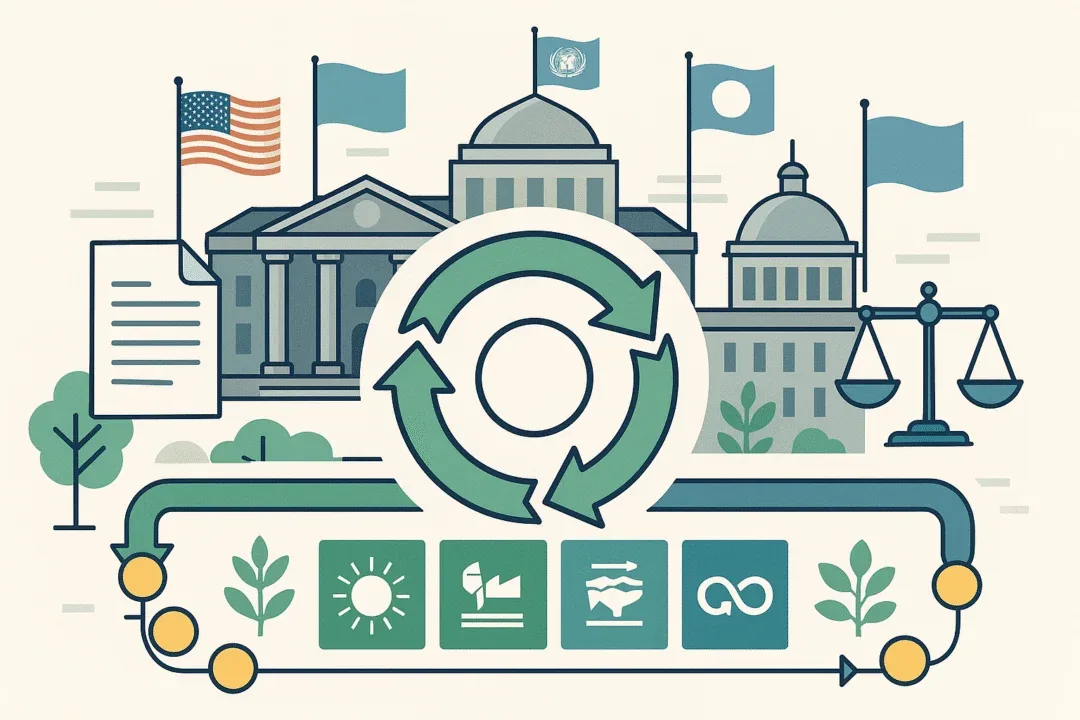
Governments and international organizations play a critical role in accelerating the circular economy through laws, regulatory frameworks, and coordinated strategies. Policy instruments create the legal and economic conditions necessary for scaling circular practices and aligning national goals with global sustainability targets.
🇪🇺 EU Circular Economy Action Plan (CEAP)
The European Commission’s CEAP, part of the broader European Green Deal, is one of the most advanced legislative frameworks supporting circularity. First launched in 2015 and updated in 2020, it focuses on designing sustainable products, boosting reuse and recycling, and reducing waste across key value chains.
Key measures:
- Mandatory eco-design standards for electronics, textiles, and packaging
- Introduction of material labeling for transparency and traceability
- Stronger enforcement of extended producer responsibility (EPR)
- Emphasis on circularity in batteries, construction, and plastics
United Nations Sustainable Development Goals (SDGs)
The UN SDGs, particularly Goal 12 (Responsible Consumption and Production) and Goal 13 (Climate Action), support the circular economy as a pathway to sustainable global development. Circularity intersects with targets on waste reduction, sustainable business models, and resource efficiency.
Global alignment:
- Circular strategies help nations meet climate commitments under the Paris Agreement
- CE models contribute to biodiversity protection under the Kunming-Montreal Global Biodiversity Framework
🇺🇸 National and Regional Circular Economy Policies
Countries around the world are embedding circularity into their national legislation and green transition plans.
Examples:
- United States EPA promotes circular innovation via the National Recycling Strategy and extended material recovery goals
- China’s Circular Economy Promotion Law mandates recycling, remanufacturing, and industrial symbiosis
- Japan’s Circular Economy Vision 2020 focuses on value creation through resource productivity and closed-loop systems
Policy Instruments & Compliance Frameworks
Governments deploy multiple instruments to enforce and incentivize circular practices:
Types of instruments:
- Regulatory tools: waste directives, product standards, take-back obligations
- Market-based tools: tax incentives, carbon pricing, green public procurement
- Compliance frameworks: mandatory EPR, product passport systems, and digital compliance tracking
Example: The Right to Repair movement has led to legislation in the EU and several US states requiring manufacturers to provide spare parts and repair documentation.
Global Collaboration & Trade Alignment
Multilateral organizations and trade blocs are working to align circular economy standards globally:
- The OECD promotes policy coherence and cross-border material flow tracking
- The World Circular Economy Forum (WCEF) facilitates knowledge exchange and global cooperation
- Circularity is being integrated into trade negotiations through WTO environmental goods discussions
From the EU Green Deal to the UN SDGs, circular economy policy is evolving into a global compliance and innovation framework. Government regulation, backed by policy instruments and international cooperation, is essential to scale circular solutions and achieve sustainable economic transformation.
Consumer Behavior & Circular Participation

Consumer behavior is a critical driver of the circular economy, influencing demand for sustainable products, reuse practices, and waste reduction. Engaging individuals through education, incentives, and behavior design can accelerate the transition from linear consumption to participatory circularity.
Behavioral Economics and Circular Decisions
Behavioral economics helps explain why consumers often act against their environmental intentions. Circular models benefit from using choice architecture and green nudges – subtle design cues that steer behavior toward sustainable options without restricting freedom.
Examples of nudging:
- Defaulting to reusable packaging at checkout
- Highlighting eco-labels and sustainability scores on product displays
- Structuring loyalty programs around refill, return, or repair actions
Adoption of Circular Consumption Habits
Circular behavior includes buying refurbished, sharing instead of owning, repairing before replacing, and recycling properly. Adoption of these circular habits depends on access, affordability, and perceived value.
Key trends:
- Growth in second-hand marketplaces (e.g., Vinted, ThredUp)
- Rise of subscription and leasing services for clothing, appliances, and electronics
- Popularity of DIY repair movements and zero-waste communities
Consumer Education and Awareness
Sustainable consumption requires awareness of environmental impacts and actionable alternatives. Consumer education campaigns improve participation in programs like take-back systems, textile recycling, or composting.
Effective strategies:
- Visual cues and storytelling about product lifecycles
- Mobile apps showing recyclability or repair guides
- Transparency via eco-labeling, carbon scores, or product passports
Cultural Shifts and Recycling Norms
Developing a recycling culture and normalizing reuse are vital for long-term behavior change. Circular participation becomes mainstream when sustainable choice frameworks are built into everyday life.
Behavioral drivers:
- Social norms and peer influence (e.g., neighbors composting or using reusable bags)
- Identity alignment with eco-conscious values
- Community-level initiatives like tool libraries and sharing networks
Barriers to Participation
Despite rising awareness, key behavioral barriers persist:
- Perceived inconvenience of circular options
- Lack of product transparency or service availability
- Higher upfront cost or effort compared to linear alternatives
Solutions include:
- Simplifying access to repair services and return programs
- Scaling green defaults in digital and retail environments
- Supporting participatory circularity through local hubs and digital tools
Behavioral change and consumer engagement are essential for scaling the circular economy. By integrating green nudges, improving education, and normalizing sustainable choices, circular consumption can become both desirable and habitual.
Future of Circular Economy: Global Integration & Innovation

The future of the circular economy lies in global integration, systemic innovation, and digital intelligence that enables resource efficiency within planetary boundaries. As economies align with sustainability goals like the UN SDGs 2030, circularity will evolve from a niche strategy to a foundational principle of global economic growth.
Global Adoption and Trade Alignment
The global material flow is becoming increasingly interconnected, making international cooperation essential for scaling circular systems. As more countries embed circular principles into climate strategies and green industrial policy, cross-border alignment of standards, product passports, and take-back regulations will be critical.
Key shifts:
- Circularity included in trade negotiations (e.g. WTO environmental discussions)
- Integration of extended producer responsibility (EPR) into export/import frameworks
- Rise of circular trade zones promoting remanufacturing and material recovery
AI-Enhanced Circular Intelligence
AI and predictive lifecycle modeling will shape the next generation of circular systems by optimizing design, maintenance, reuse, and recycling. Circular intelligence – powered by AI, IoT, and big data – will enable hyper-efficient material flows and real-time decision-making across entire value chains.
Future capabilities:
- Predictive lifecycle analysis for durability and reuse planning
- AI-driven design feedback loops for modular and repairable products
- Autonomous reverse logistics and smart disassembly robotics
Circular Economic Metrics & Growth Models
The shift to circular GDP measures will redefine how nations evaluate economic success – not by throughput, but by value retention, resource productivity, and emissions reduction.
Innovative metrics may include:
- Material circularity indicators (MCI)
- Planetary budgeting models to track alignment with ecological thresholds
- Carbon-adjusted productivity to balance economic and environmental performance
Systemic Innovation and Next-Gen Solutions
Future circular economies will be driven by systemic innovation – the integration of design, technology, policy, and culture to reimagine products, services, and infrastructures.
Emerging trends:
- Bio-based materials replacing petrochemicals
- Circularity in space technologies and rare earth recovery
- Decentralized manufacturing with 3D printing and local materials
Alignment with Planetary Boundaries
As climate pressures intensify, circularity will be essential for operating within planetary boundaries, ensuring that material use, land use, and emissions remain within safe ecological limits.
Strategic alignments:
- Supporting climate adaptation through circular urban infrastructure
- Enhancing biodiversity through regenerative supply chains
- Integrating circularity into national carbon neutrality roadmaps
The future of the circular economy is intelligent, integrated, and essential. Driven by AI-powered optimization, global policy alignment, and next-gen innovation, circularity will become the foundation of sustainable economic growth through 2030 and beyond.
FAQ’s
What is the circular economy?
The circular economy is a regenerative economic model that minimizes waste, keeps resources in use, and reduces environmental impact by closing material loops through reuse, recycling, and sustainable design.
How does the circular economy differ from the linear economy?
A linear economy follows a take-make-dispose model, while a circular economy maintains value through reuse, repair, and recycling, reducing waste and resource depletion.
What are the main principles of the circular economy?
The three main principles are: design out waste and pollution, keep products and materials in use, and regenerate natural systems.
Which industries are adopting circular economy practices?
Industries such as construction, fashion, and electronics are leading in circular innovation through material reuse, repairability, and closed-loop systems.
How does the circular economy benefit the environment?
It reduces greenhouse gas emissions, diverts waste from landfills, conserves natural resources, and supports climate resilience through sustainable resource use.
What role do digital technologies play in circular systems?
Technologies like IoT, AI, and blockchain enable real-time tracking, predictive lifecycle management, and supply chain transparency in circular models.
What are circular business models?
Circular business models include Product-as-a-Service, leasing, repair, remanufacturing, and take-back systems that keep materials in use and create recurring value.
How is the circular economy financed?
Funding comes from green bonds, ESG investment, impact funds, and public-private partnerships, supporting circular startups, infrastructure, and innovation.
What are key policies supporting the circular economy?
Policies like the EU Circular Economy Action Plan, the UN SDGs, and national waste directives enforce standards and promote circular innovation worldwide.
What is the future of the circular economy?
The circular economy will evolve through AI-driven optimization, global policy integration, new economic metrics, and systemic innovation aligned with planetary boundaries.
References and Sources